
Sebastia inscribed as a World Heritage Site in Palestine
Emek Shaveh congratulates the State of Palestine, the Municipality of Sebastia and the people of Sebastia on the addition of Sebastia to the UNESCO list of World Heritage Sites.
Sebastia’s Inscription as a World Heritage Site (WHS) in Palestine, and as a World Heritage Site in Danger, recognises both its exceptional importance and Palestine’s status as the State Party responsible for its protection. Israeli expropriation and development plans threaten to divide the World Heritage Site in two by severing the ancient acropolis from the historic village by the same name and depriving the Palestinians of their livelihood and cultural heritage. In addition it violates Israel’s obligations under international law, in particular to the 1972 Convention Concerning the Protection of the World Cultural and Natural Heritage.
On July 24th, 2026 The World Heritage Committee voted to inscribe Sebastia through the emergency procedure under criterion (iii), recognising the unique testimony it bears to the successive civilisations that inhabited the site. At the same time, the Committee placed Sebastia on the List of World Heritage Sites in Danger, reflecting the immediate threats posed by the massive Israeli land-expropriations, the unilateral archaeological activity by the Staff Officer for Archaeology (SOA) within the Israeli Civil Administration (ICA), and the plan to develop the site as a settler-run park which threatens to sever the ancient acropolis from the historic Palestinian village.
The inscription is an important achievement for Palestine and for the residents and institutions that have worked for many years to conserve Sebastia’s extraordinary heritage. ICOMOS, UNESCO’s advisory body for cultural heritage, recommended Sebastia’s inscription on an emergency basis and its simultaneous addition to the List of World Heritage in Danger.
The inscription is an affirmation that Sebastia’s acropolis, the historic village, and the landscape surrounding them constitute one integral historic and cultural zone. Its inscription as a World Heritage Site in Danger is also a warning that Israeli plans to divide the acropolis from the living Palestinian village would destroy the coherence and physical interconnectedness for which Sebastia has been inscribed.
The Oslo Accords had created an anomaly at the site, whereby the historic town of Sebastia is situated in Area B, under Palestinian civilian governance but subject to Israeli security control, while the acropolis and other significant portions of the site are located in Area C, under full Israeli control. The World Heritage designation encompasses both sections (C and B), confirming the historical and cultural contiguity of the site in its entirety. Protection of the site by the rightful custodians will necessitate Israel allowing the Palestinian Authority access to and enabling professional preservation measures at the section of the section of the site which is situated in Area C.
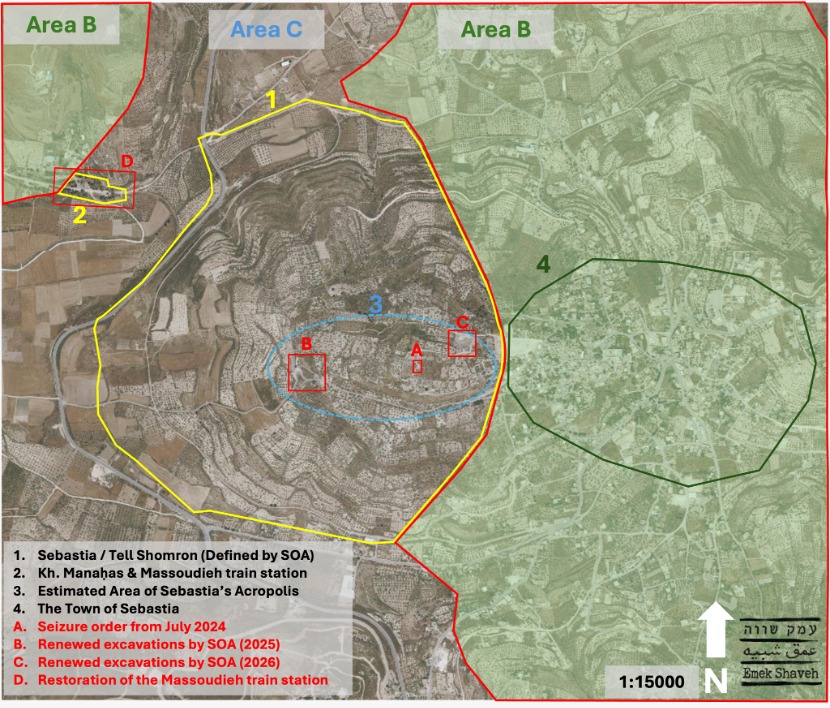
Map of Sebastia showing the archaeological polygon and the two different designations assigned to areas of the site by Oslo II (Areas B and C).
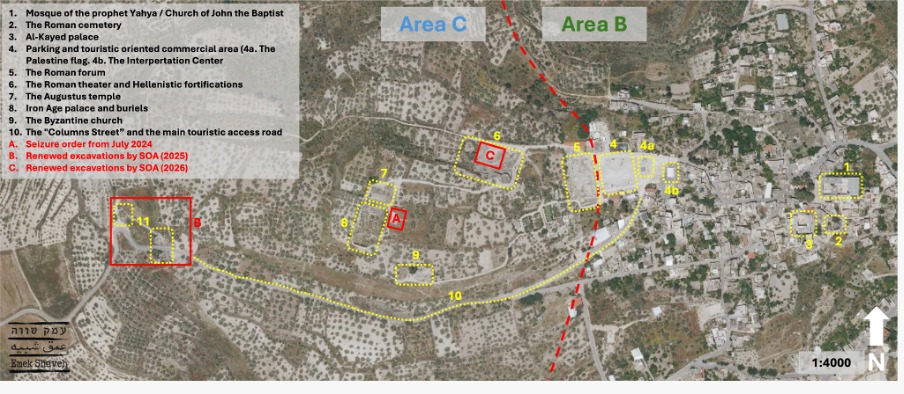
Map of Sebastia with main sites across both areas (C and B)
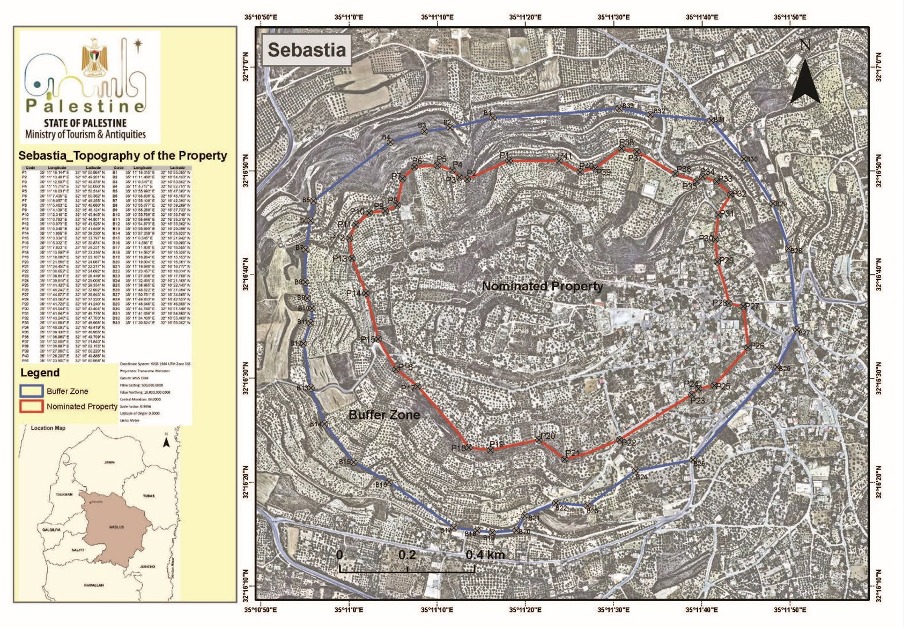
Map of nomination boundaries submitted by the State of Palestine as seen in ICOMOS evaluation report.
Emek Shaveh’s Statement:
We congratulate the State of Palestine, the Municipality of Sebastia, and the people of Sebastia on this historic recognition. The inscription affirms that Sebastia is the shared cultural heritage of humanity and that the residents of the town Sebastia and the State of Palestine are the rightful custodians of that heritage.
The present-day village stands within the ancient settlement and incorporates Roman, medieval, Islamic, Crusader and Ottoman remains. Detaching the acropolis from the village and presenting it as a self-contained biblical site under exclusive Israeli control would destroy the integrity of the site.
ֿConservation cannot serve as a pretext for expropriation, exclusion, unilateral excavation or the replacement of a living Palestinian heritage economy with a site controlled by the occupying power and oriented towards settlements and Israeli tourism. The international community must ensure that the inscription is translated into meaningful protection. Israel must halt the expropriation process and all development, excavation and infrastructure work that could alter the site without the participation and consent of the competent Palestinian authorities and the local community.
In addition, we call on Israel to honor its commitments under the 1972 Convention Concerning the Protection of the World Cultural and Natural Heritage, and to allow experts and professionals on behalf of the Palestinian Authority, as well as the residents of Sebastia, access to the part of the site located in Area C to carry out the necessary restoration work to ensure that the site’s authenticity and integrity are preserved and safeguarded.
Background:
Sebastia is situated northwest of Nablus in the northern West Bank. Its archaeological and architectural remains record six thousand years of political, urban, cultural and religious history.
The site is widely identified with Samaria, the Iron Age capital of the northern Kingdom of Israel and an important regional political centre from the ninth century BCE. During the Hellenistic period it became a fortified stronghold. Herod rebuilt the city during the Roman period and renamed it Sebaste in honour of Augustus. It later became a Roman colony and, during the Byzantine period, the seat of a bishopric.
A Crusader built cathedral in the village, built on the remains of a Byzantine church dedicated to St. John the Baptist, was later turned into the Nabi Yahya mosque (the name in Arabic for John the Baptist), reflecting the site’s importance within both Christian and Muslim traditions. During the late Ottoman period, Sebastia was one of Palestine’s notable “Throne Villages”, rural political and administrative centres governed by prominent local families.
The Palestinian nomination proposed inscription under criteria (ii), (iii) and (vi). ICOMOS concluded that of the three criteria proposed, criterion (iii) had been demonstrated, identifying the specific and compelling source of Outstanding Universal Value as the exceptional visibility and legibility of the site’s main historical layers. Within a single archaeological property, remains from the Iron Age, Hellenistic, Roman and Byzantine periods, the early Islamic periods together with later Crusader additions, continue to coexist in a form that makes the successive development of the settlement unusually clear. Unlike many continuously inhabited cities, where later construction has concealed or destroyed earlier phases, Sebastia preserves relatively direct archaeological traces of successive political, religious and urban systems that remain physically interconnected.
The World Heritage inscription is especially significant because it rejects the artificial separation of Sebastia’s archaeological acropolis from the Palestinian town. The western part of Sebastia contains the prominent mound and acropolis, with substantial remains from the Iron Age, Hellenistic and Roman periods. The eastern part contains the present-day village, which itself stands on earlier remains and incorporates the historic core, the Nabi Yahya mosque and former Crusader cathedral, Ottoman-period houses, public spaces, agricultural terraces and traditional pathways.
Since 1967, Israel’s actions at archaeological sites in the West Bank have been characterized by exclusion of Palestinian communities, development of settler-led tourism, and systematic violations of international law. Under the Oslo Accords, the archaeological mound and much of the western section were classified as Area C, under full Israeli control, while the Palestinian village was classified as Area B, under Palestinian civil administration but overriding Israeli security control. This division was intended to be temporary. More than thirty years later, it continues to prevent the site from being protected and managed as a single landscape.
The inscription also recognises that the eastern section of the site in Area B has been protected and sustained by the Palestinian community despite severe political and administrative restrictions.
The condition of the site differs markedly between its western and eastern sections. The 2020 Conservation Master Plan described parts of the western archaeological area under Israeli control as abandoned and lacking systematic landscape management, with vegetation growing among exposed remains. By contrast, the eastern section containing the present-day village has benefited from sustained conservation and rehabilitation. Since 2005, the Municipality of Sebastia, the Palestinian Ministry of Tourism and Antiquities and partner organisations have undertaken projects to stabilise historic structures, restore public spaces and rehabilitate the historic core. These efforts also involved local residents receiving training in conservation techniques, allowing heritage protection to create employment, professional knowledge and a renewed relationship between the community and its historic environment. For an in-depth account of the conservation efforts taken by the people of Sebastia, the PA and partner organizations see here.
Over the past six years, Israeli governmental bodies and settler organizations have significantly intensified efforts to sever Sebastia’s acropolis (Area C) from the historic town (Area B), undermining local conservation, and restricting access through expanding militarisation. In this context it should be mentioned that the right-wing NGO “Preserving Eternity” which has significant influence on the current government, especially the Minister of Heritage, Amihai Eliyahu, have called last week for the Israeli government to halt UNESCO’s recognitions of sites as World Heritage Sites in Palestine and encouraged Israel to place a “yellow line” around sites in Area B and A as well, referring to the “yellow line” Israel uses in the Gaza strip to enforce its control over 60% of the Strip. It is known that anyone who crosses the yellow line in Gaza is likely to be shot.
In May 2023, the Israeli actions at Sebastia escalated when the government approved Government Plan no. 491, allocating 32 million NIS to develop the site into an Israeli, settler-run tourist attraction. In 2024 the military issued a seizure order for the summit of the site and in May 2025, SOA commenced new excavations at the site. A second excavation commenced earlier this month.
The most drastic development occurred on November 19th 2025, when the Israeli Civil Administration (ICA) published its intention to expropriate the entire archaeological acropolis of Sebastia and a vast surrounding area, a total of 1800 dunams, including privately owned land belonging to residents of Sebastia and the neighbouring village of Burka. This measure aims to detach the archaeological site from the town, reroute access directly to Road 60, and establish a settler-managed tourist site—ending centuries of cultural continuity and destroying Palestinian-led tourism, the main economic lifeline for the community.
In February 2026, the residents of Sebastia received notification from the ICA that their initial objections to the expropriation order were rejected and a second more definitive and expansive expropriation order was issued entailing over 2000 dunams.
Since the issuance of the land expropriation order, the residents of Sebastia and Emek Shaveh have demanded that the ICA cancel the expropriation, or at the very least present the grounds for such an extensive measure. The ICA rejected all claims and has so far refused to present the reasons and justifications for seeking such a broad expropriation for the purpose of “developing the archaeological site.”
Once all appeals were rejected, the residents of Sebastia filed a petition with the High Court of Justice (HCJ). Emek Shaveh provided an archaeological-legal expert opinion, and as of now, the HCJ has issued an injunction freezing the expropriation pending the State’s position in August 2026. This is no guarantee for future outcomes, as the HCJ has proven time and again that it legitimizes Israel’s actions in the West Bank.
These cumulative actions at Sebastia coincide with mass site declarations in the northern West Bank, expansion of SOA’s authority into Area B and A, and efforts to extend Israeli antiquities law into the West Bank and are advancing the cause of the illegal annexation of land including historic sites.
These constitute violations of the 1995 Oslo Accords as well as the 1954 Hague Convention and its protocols, contradict the 2024 Advisory Opinion of the International Court of Justice, and undermine multiple UN resolutions concerning cultural property in occupied territories as described in the report by the Independent International Commission of Inquiry on the Occupied Palestinian Territories (see paragraph 64 on Sebastia).
If Israel pushes forward with the plans to seize the site from the Palestinians, it will now be in violation of Article 6 of the 1972 World Heritage Convention to which it is a signatory which stipulates that a state party must not take any deliberate measures to threaten the World Heritage Site of other State parties.
In 2014 the inscription of the Land of Olives and Vines – Cultural Landscape of Southern Jerusalem, Battir assisted in the cancellation of a plan promoted by the Israeli government to construct a segment of the Separation Wall between Israel and the West Bank in proximity to Battir, a decision which would have led to the destruction of the traditional agricultural landscape hundreds of years old. Battir served as an important precedent, at the time, demonstrating how inscribing a site can halt damaging and annexationist measures. However, in recent years this protection has waned as Israel has authorized the establishment of a new Jewish settlement in the core zone of the World Heritage site. Thus, while the recent inscription of Sebastia to the World Heritage List serves as an important step in safeguarding the cultural heritage of Sebastia, it is important to continue monitoring developments in this area and to demand that Israel abide by the conventions to which it is a signatory.
In conclusion, the situation arising from the inscription of Sebastia as a World Heritage site poses a challenge for the State of Israel, placing its plans at odds with a convention from which it benefits greatly. The inscription of Sebastia as a World Heritage site and as a World Heritage Site in Danger obligates all parties: Israel, Palestine, and the international community to ensure that the site remains intact and protected.
In light of Sebastia’s inscription on the World Heritage List as a site in the State of Palestine, Emek Shaveh calls on the international community to support the Palestinian Authority and the residents of Sebastia in conserving and sustainably developing the site. Such support must enable the local community to benefit fully from tourism and agriculture, which constitute the town’s principal economic lifelines.
ICOMOS is well placed to provide the expertise and professional support required to develop the site in accordance with the Sustainable Development Goals. A community-centred approach would safeguard Sebastia’s authenticity and integrity while ensuring that its residents benefit economically, culturally, educationally, and socially. Any future development must respect Palestinian rights and sovereignty and comply with international law and accepted ethical standards for the management of cultural heritage.