
Alert: Jerusalem Cable Car Project Advances; Authorities Crack Down on Palestinian Olive Harvest in Wadi Rababa/Hinnom Valley
In a highly concerning development, Emek Shaveh has learned that the Jerusalem Development Authority (JDA) is planning to contract a company based in Italy to serve as a consultant for the construction of a cable car from the West Jerusalem neighbourhood of Baka to a settlers-run visitors center slated to be built at the entrance to Silwan/City of David across from Dung Gate. The notice of intent was published on September 14th (in the midst of the Jewish High Holidays season) by the JDA to award a contract, foregoing a need for a tender, to a company named ROPES: Ropeway Engineering.
ROPES GmBH (registered in Italy as Ropes S.r.l.) is a ropeway engineering consultancy based in South Tyrol, Italy. The firm provides line calculation, static and safety analysis, audit and certification, traffic planning and master planning for alpine and urban environments. It belongs to the Ropeway Project Group, a network of six companies (including the accredited inspection body WPK Austria) that reports more than 50 completed ropeway projects worldwide, in Turkey, India, Germany, and more locations.
The development comes four years after the High Court upheld the cable car plan in 2022, despite the fact that it was advanced in an irregular planning process and was met with massive public opposition by Israeli heritage professionals, planners and internationally renowned architects. In the interim we are aware that the implementation of the project has been delayed at least partly because the political nature of the project deterred foreign companies from engaging with it.
The progression of this project should be scrutinised in light of the 2025 UN Independent International Commission of Inquiry’s findings on the use of archaeology and tourism to advance the settlement enterprise in East Jerusalem, particularly in Silwan and the City of David. This is especially relevant given the cable car’s planned route and its connection to these sites. Furthermore, the ICJ’s 2024 Advisory Opinion found that “the Israeli settlements in the West Bank and East Jerusalem, and the regime associated with them, have been established and are being maintained in violation of international law,” and held that all States have an obligation not to recognize as legal the situation arising from Israel’s unlawful presence in the Occupied Palestinian Territory, including East Jerusalem, or to render aid or assistance in maintaining that situation”.
The Court further specified that this includes an obligation to Member States “not to recognize any changes in the physical character or demographic composition, institutional structure or status of the territory occupied by Israel on 5 June 1967, including East Jerusalem,” therefore “to abstain from entering into economic or trade dealings with Israel concerning the Occupied Palestinian Territory or parts thereof which may entrench its unlawful presence in the territory” and “to take steps to prevent trade or investment relations that assist in the maintenance of the illegal situation created by Israel in the Occupied Palestinian Territory” (para. 278).
Jerusalem’s proposed cable car: developments and background:
The planned 1.4-kilometre route would link the First Station complex in West Jerusalem with Mount Zion and terminate at the proposed Kedem visitors center, the 16,000 square meter tourism hub advanced by the Elad settler organization to be built at the entrance to Silwan and the City of David site, opposite the Old City’s Dung Gate. Approximately 15 pylons, reaching up to 26 metres, would carry cars across the Hinnom Valley and above Palestinian homes in the neighbourhood of Silwan. Its advertised capacity is approximately 3,000 passengers per hour.
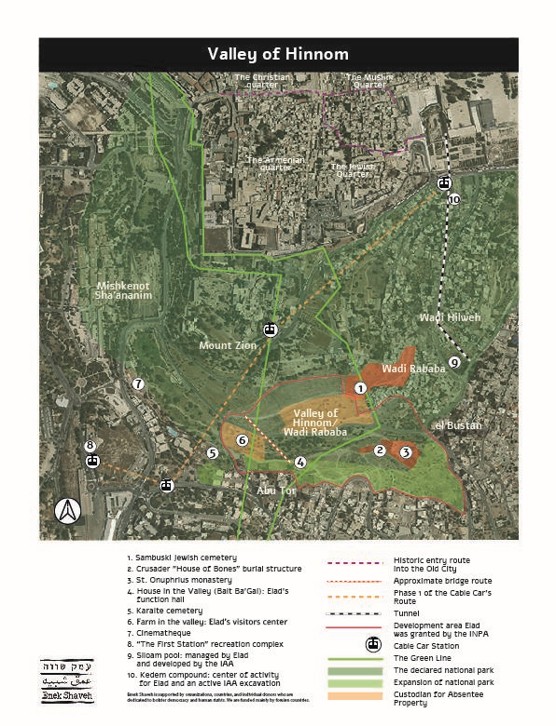
of Jerusalem Nir Barkat said that the purpose of the project was to encourage users to “understand who is truly the landlord of the City.”
The controversial plan was promoted by the Ministry of Tourism and the JDA, and advanced through the National Infrastructure Committee (NIC), in a process which largely circumvented considered public objection, in contrast to standard planning procedures. Over a thousand objections had been submitted to the plan. Seventy Israeli public intellectuals, archaeologists, and architects signed a public statement against the plan, and 27 internationally renowned architects sent a letter to the Israeli government calling it to halt the project that will subordinate Jerusalem’s historic landscape to short-term political interests and dramatically alter the Old City Basin, which “constitutes a heritage asset for all of humanity.” Signatories included Santiago Calatrava, Thom Mayne, Peter Eisenman, Ron Arad and Moshe Safdie.
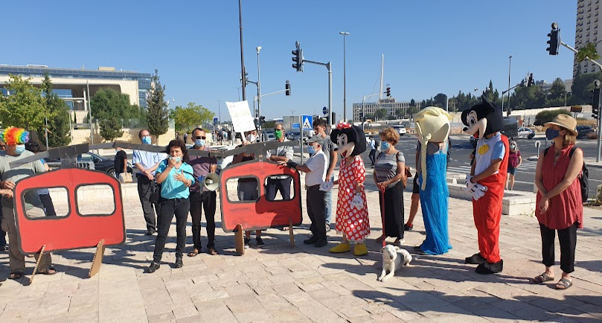
“Jerusalem is no Disneyland”, a demonstration against the cable car project in front of the High Court during a hearing of the petitions against the cable car (29.6.2020).
In a New York Times article about the cable car project, renowned Israeli architect Moshe Safdie called the project “a total outrage against a fragile city”.
Emek Shaveh convened a group of organizations opposing the cable car forming the “Coalition for the Preservation of the Historic Basin.” The residents of Silwan, Emek Shaveh, Adam Teva V’Din (an environmental organization), and the Jewish Karaite Community petitioned against the plan, but in May 2022 the High Court rejected the petitions and greenlighted the project.
Despite the legal victory, the project’s implementation has faced difficulties, chief among them the failure to secure the necessary international participation. In 2024 it was reported that the French company CNA and the Swiss company, Histec Engineering, pulled out of the project.
In the meantime, in July 2023, the Jerusalem Municipality announced that it will expropriate 10,000 square meters for the project, much of which included land belonging to Palestinian residents of Silwan. Attorney Sami Arshid, who represents the Palestinian residents of Silwan against the expropriations, said:
“This is the most unnecessary project in the history of the city. The residents of Silwan and the Old City, like most experts in Israel and around the world, see it as a serious hazard to the city’s urban heritage. The expropriation of properties and homes will cause severe harm to the residents and this in order to establish a megalomaniacal project that harms the history, urban heritage and landscape of the Old City of Jerusalem and its environs.”
In 2025, the Ministry of Transport joined the Ministry of Tourism in advancing the cable car. The new cost assessment provided by Netivei Yisrael (the national transport infrastructure company) was estimated at 473 million NIS, more than double the initial budget for the project.
Emek Shaveh’s Response: As we have repeatedly stated, this project threatens the Palestinian communities of Silwan and the timeless landscape of Jerusalem’s historic core. Over the years, its planners have failed to demonstrate that the cable car will meet any transportation need. It is clear that the project’s central motivation is to consolidate the settlers’ hold on Silwan and adjacent areas as part of an effort to displace Palestinians from the Historic Basin and reshape Jerusalem’s cultural landscape.
More specifically, the project aims to reroute tourism away from the established routes through the Muslim and Christian Quarters, bypassing the historic approaches through Damascus and Jaffa Gates and seeks to funnel visitors through the settler-controlled City of David site.
If implemented, the plan will marginalize the Muslim and Christian Quarters and threaten their economies with collapse. The initiative is underscored by a desire to undermine Jerusalem’s multicultural and multifaith character which has defined it for thousands of years and transform the Historic Basin into a space dominated by an ultranationalist, exclusivist vision for the city.
In light of this, Emek Shaveh calls on professionals in Israel and abroad to:
- Call for an immediate halt to this highly destructive project which threatens the city’s multicultural historic landscape, sacred to Jews, Muslims and Christians worldwide, and which deals a severe blow to Palestinian life in the city.
- Call on Israel to respect its obligations under international law, its obligations to the international community and to respect the outstanding universal value of Jerusalem’s Historic Basin.
- Call for a full disclosure of the project’s plans and expenditures to date (over 30 million NIS so far), and explain why nearly 50 suppliers were selected without a tender.
- Wadi Rababa/Hinnom Valley Olive Harvest
On Saturday, October 3, 2026, Palestinian families began the annual olive harvest in the Hinnom Valley/Wadi Rababa, returning to plots they have cultivated for generations. These lands are now subject to an accelerated takeover by the Elad Foundation and the Nature and Parks Authority (INPA). Emek Shaveh accompanied the families to document the harvest.
After several hours, settlers arrived with police officers and an INPA inspector. They stopped the harvest, confiscated approximately 60 kilograms of freshly picked olives, and summoned six Palestinian family members and an Emek Shaveh employee for questioning on suspicion of “damaging a national park.” The inspector claimed that the land had been taken over under the Absentees’ Property Law and that its location within the Jerusalem Walls National Park provided grounds to prevent the families from harvesting their own olives.
On Sunday (October 4, 2026), Emek Shaveh’s spokesperson appeared for questioning and submitted his account.
This incident forms part of a broader pattern of Israeli efforts to obstruct the olive harvest across East Jerusalem and the West Bank, attacking Palestinian livelihoods, undermining cultural traditions, and turning the cultivation of ancestral land into grounds for exclusion and criminalization.
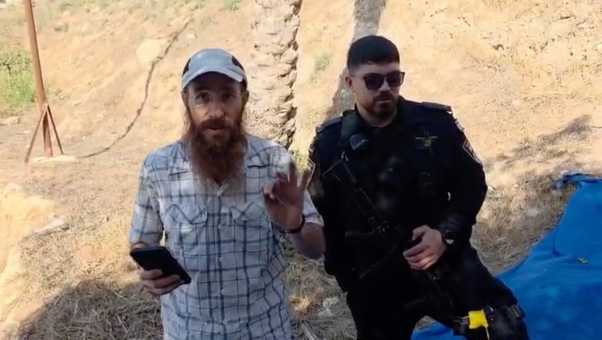
The INPA’s inspector, Eliezer Gelber, with a Police officer talking to Emek Shaveh’s spokesperson (not pictured) on October 3, 2026.
The land where the harvest took place has been cultivated for generations by families from Silwan, in this case the Sumrin family. In 2020, the Elad settler organization and the Israel Nature and Parks Authority began development works on an extension of the City of David project, what is now known as “The Farm in the Valley”, a biblically themed agriculture park. Absentee Property procedures were initiated for some of the plots while other plots were “borrowed” through a mechanism called ‘Gardening Orders’, which allows the authorities to make use of privately owned land for public purposes.
Over the past six years we have witnessed how the biblical farm has expanded throughout the entire eastern section of the valley and the Palestinians increasingly pushed out. Whereas in the previous years, the families were able to harvest their olives, this year’s aggressive suppression of the harvest and the subsequent summons to a police investigation mark an acute escalation and joins other devastating measures against the residents of Silwan and the surrounding neighbourhoods designed to displace them from their homes and lands.
For more background about the settler-led projects in the Hinnom Valley/Wadi Rababa see here.
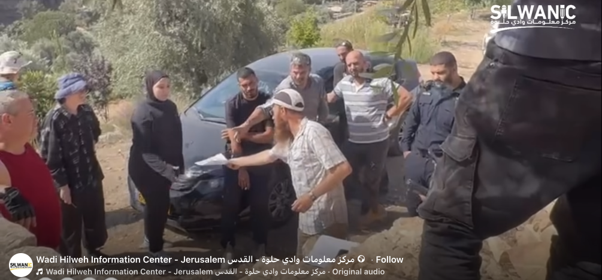
INPA inspector issues a summons to an investigation to the Palestinians harvesting olives in Wadi Rababa (still image from video by Wadi Hilweh Information Center – Jerusalem)
Emek Shaveh’s response: The latest incident in Hinnom Valley/Wadi Rababa demonstrates yet again how the settlers and the authorities are acting hand in hand to shrink Palestinian space and reshape the Historic Basin of Jerusalem as a biblical theme park.
This is part of a wider process of displacement, appropriation and violation of rights of Palestinian communities. In this latest case, we are also witnessing an attempt to intimidate civil society organizations seeking to monitor and defend Palestinian communities from the brutal actions of the settlers and the authorities. The grounds for summoning the harvesters to an investigation are particularly absurd given that these families have been cultivating and harvesting these trees for generations.
The Israeli authorities’ and settler’ attempts to transform the valley constitute an assault on the fabric of life in the city and the multicultural and multifaith cultural landscape. These efforts rely on draconian laws such as the Absentees’ Property Law, that the High Court of Justice has said would not pass judicial review if it were enacted today.