
Palestinian communities living near ancient sites in the West Bank face extreme pressure by home demolitions and settler violence
amateur archaeologist Zeev Erlich who was killed in an attack by Hezbollah in November 2024. Ehrlich, who was a civilian, was allowed by reserve officer Yoav Yarom to enter Lebanon and inspect a fortress at Qalaat Shamaa where he was killed together with Sgt. Gur Kehati in an incident that ended with Yarom’s dismissal from service (although he was not indicted by the military advocate general).
The incident exposed the depth of cooperation between settlers driven by a passion for entering no-go areas to pursue antiquities associated with Jewish periods irrespective of the law or safety concerns and the military which has increasingly enabled these reckless, unprofessional and often illegal adventures. According to Rotter’s own account, he first encountered the stone in 2017 during a tour of Palestinian villages with Ehrlich.The stone at the time was embedded in a lintel of a building and Ehrlich noted it had a carving of a reed lamp.
In the following video Rotter says:
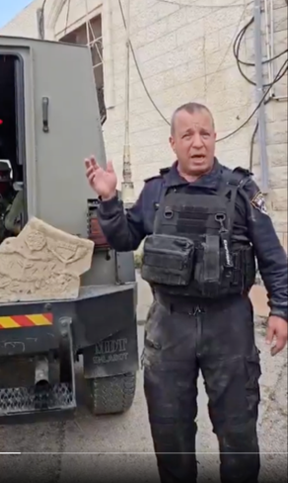
A few years ago, Jabo [Zeev Erlich] visited and saw a repurposed stone. It had a decoration of a meno
rah, which was familiar to us from other places. We find Samarian menorahs in Jitt, Kafr Qaddum, Haja. … Here too, in Kafr Dhanba, we find a lintel with a menorah. After our visit, the residents realize that there is something here that might be worth money, worth gold. I don’t know what it is worth. They dismantle the lintel and the lintel is waiting, apparently to be sold to antiquity robbers. In a search of the village, we found the stone thrown in one of the courtyards, and we will save it. This is a matter of heritage; we are returning a lost object to its owner.” (Click here to see video)
Meir Rotter in Dhanba, March 13th, 2026, frame from video
Marajam
Yesterday morning, March 23rd 2026, the Israeli Civil Administration (ICA) destroyed a home in the small village of Marajam, located a kilometer southwest of Duma. The small structure was situated on the periphery of an archaeological site. In an expert opinion that Emek Shaveh wrote as part of the objection to the demolition order, we determined that the house which is situated on the margins of the site, poses no threat to the archaeological remains. We further noted that the village’s residents have long lived alongside the site with an awareness of its significance, taking care to avoid causing damage to the artefacts. The objection was recently rejected.
The boundaries of the archaeological site at Marajam were designated in May 2025 by the SOA, as part of a broader wave of site declarations across the northern West Bank. This surge in designations has coincided with the establishment of multiple outposts in the area and a marked increase in settler violence.
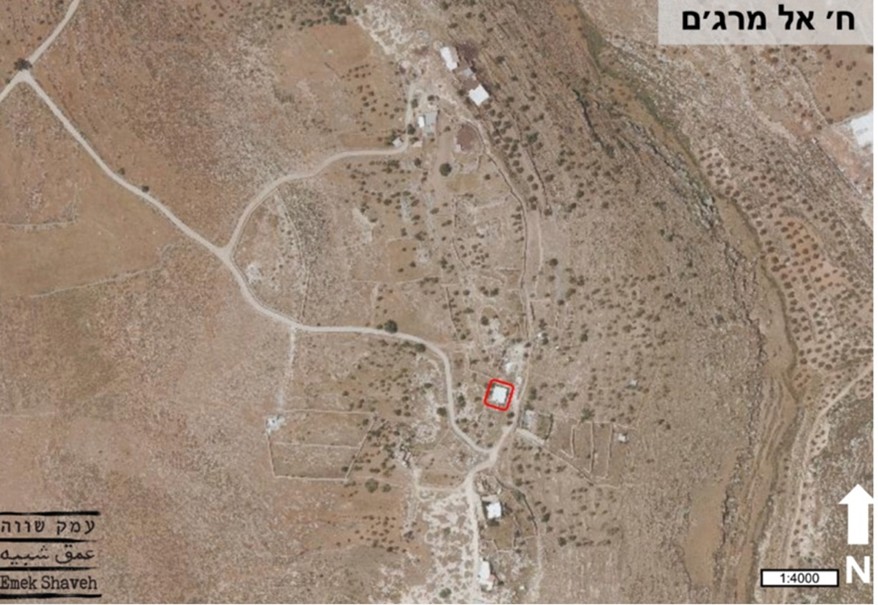
Marajam with house now demolished in red square
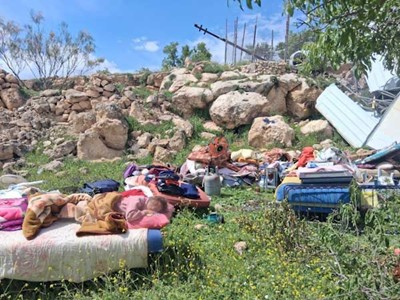
Member of Masalem family in Marajam following the demolition yesterday (photo by Sharon Casper)
The boundaries of the archaeological site at Marajam were designated in May 2025 by the SOA, as part of a broader wave of site declarations across the northern West Bank. This surge in designations has coincided with the establishment of multiple outposts in the area and a marked increase in settler violence.
Background
Marajam (or Khirbet el-Marjame: 234000/661600) is an archaeological site (about 61,500 sqm or 61.5 dunam) and the site of a small community in Area C. The outposts of Michtam Le’David, Giborei David, Gal Yosef and Malachei HaShalom established in recent years by settler Eliav Libi effectively encircle the village.
The community, comprising several families engaged in goat herding, lives among the antiquities, representing the most recent layer of habitation at a site with remains dating back to the Middle Bronze Age. Their homes are modest, consisting primarily of light structures.
Like other communities in the area, residents of Marajam have faced escalating settler violence. In March 2025, a home and several vehicles were set on fire. In recent weeks, the violence has intensified significantly, with near-daily incursions by settler youth, often backed by the army. Activists from Torat Tsedek and other organisations who have been present at the site, have documented repeated incidents of harassment, vandalism and occasionally assaults. Since March 2, 2026, the area has been declared a closed military zone—barring activists from entering, while settlers continue to access the site.
Marajam was never excavated. However several archaeological surveys have been conducted at the site since the 19th century. These surveys mention a high wall surrounding the site’s summit and the remains of two impressive structures built of fieldstones dated to the Iron age. During a survey conducted between 2014-2017 by Bar Ilan University, a rock-cut tunnel system was identified. The tunnel was dated to the period before the Jewish revolt against the Roman empire (66-73 CE), despite the small number of ceramics dating to this period. The boundaries of the site declaration include all the current dwellings.
al-Fasayil
The village of al-Fasayil is located in the Jordan Valley, 14 km. north of Jericho. Nearly the last family of a shepherding community which had been living on the lands of the village had their home demolished on Tuesday, March 17th.
The Abayat family, who had lived at the site for twenty years, had sought a permit for their modest dwelling, but their request was denied, among other reasons, on the grounds that it was located within an archaeological site. The rest of the community had already been driven out several months earlier following sustained settler violence. Like with Marajam, in this case too, much of the harassment by the settlers originated from an outpost belonging to Eliav Libi (see tweet by Yehuda Shaul here).
The antiquities site includes a tel, remains of a large settlement from Roman times, and ancient aqueducts. The settlement of Tomer is situated to the south of the village.
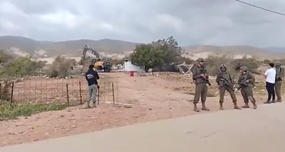
Still from demolition video. Click here to see video (source: Roni65043634 on X)
Archaeological excavations at al-Fasayil
The archaeological site at al-Fasayil is one of a series of sites along the route of the al-Fasayil stream. The al-Fasayil springs are located 1.5 km to its west. Excavations conducted in 2011 by the SOA revealed a large and highly developed settlement dating to the Roman–Byzantine period, including substantial residential complexes likely used as palatial or public buildings.
The excavations also uncovered a large bathhouse from the Byzantine and early Islamic periods, alongside a sizeable pool and an extensive aqueduct system. An additional area excavated to the south of the central site and west of the village on a hill identified as an ancient tel revealed a church as well as a square-shaped structure with a mosaic floor. Muslim burials were found within the church, indicating that the site formed part of a cemetery that remained in use for centuries.
Tel Aroma/Jabel Urma
Tel Aroma/Jabel Urma, south of Nablus and adjacent to the Palestinian town of Beita, has in recent years become a focal point of settler activity. It is located in Area B and in recent years, the settlers who identify the site as a Hasmonaean centrer have been frequenting it and accusing the Palestinians from Beita of destroying antiquities.
In recent months, Palestinian residents report the settlers are present at the site on a daily basis. Residents from the nearby settlement of Itamar tried to establish an outpost at the site but it was dismantled. Nevertheless, settlers continue to arrive regularly, and multiple incidents of violence, including attacks on Palestinians, have been reported.
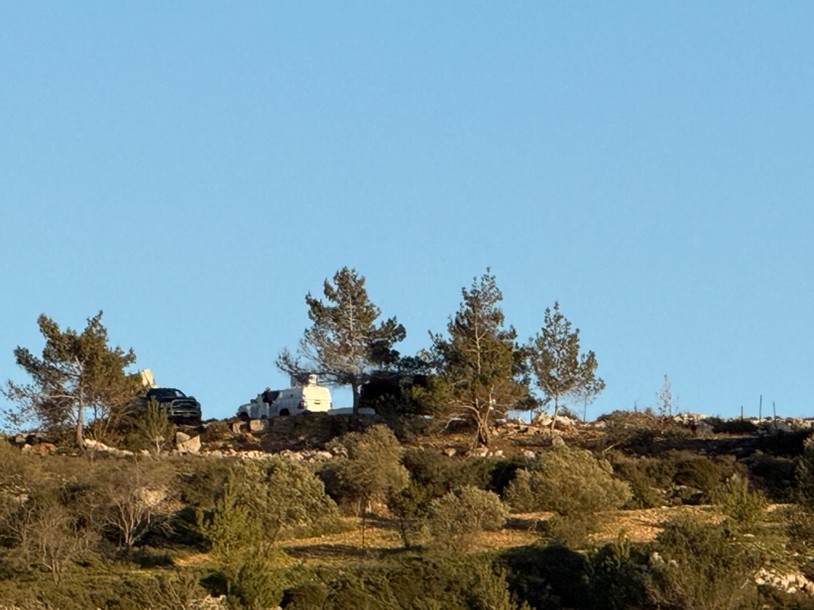
Settler vehicles at Tel Aroma/Jabel Urma earlier this month (Photo credit: resident of Beita)
Background:
Tel Aroma/Jabel Urma is an ancient fortress dating to the Hellenistic and Roman periods. Although the site has been surveyed but never excavated, some archaeologists, as well as settler groups, identify it with the Hasmonean kingdom.
In February 2020, the raising of a Palestinian flag at the site sparked a settler campaign against the local Palestinian community, who were accused of damaging the antiquities and the Jewish heritage associated with them. As part of this campaign, groups such as “Guardians of Eternity” and the Samaria Regional Council began organizing tours under the banner “liberating Tel Aroma.” One such visit resulted in clashes that led to the death a 15 years old Palestinian boy.
In recent weeks, a tour for settler youth was again organized at the site.
Emek Shaveh:
The increase in home demolitions for Palestinians living in or near archaeological sites in the West Bank which is taking place parallel to the escalation in settler violence actively and systematically supported by the Israeli authorities, undermines any pretence that restrictions on Palestinian communities near archaeological sites are motivated by a professional agenda. The claim that the Israeli authorities are acting to protect these ancient sites hardly tallies up with the situation on the ground whereby the actions by the ICA and the SOA at antiquity sites complement a widespread process of driving Palestinians from their lands. In the case of historic sites, this process serves a dual purpose: physically disconnecting Palestinians from their land while simultaneously promoting ideological campaigns that deny their historical connection to the region.
This instrumentalization of archaeology extends beyond the West Bank. In areas such as the Gaza Strip and South Lebanon, the presence of historical remnants alluding to ancient Jewish life is increasingly used by far-right groups as a justification for annexation and Jewish settlement.
The near-total silence of the Israeli archaeological community regarding these developments is no longer just concerning but suggests acceptance. The ethical responsibility of archaeologists extends beyond the retrieval of data; it includes ensuring that heritage sites are not used to violate international law or human rights in the name of science. Without a clear moral stand against the exploitation of the profession for extreme political agendas, archaeological sites will continue to be weaponized as a central means for the displacement of Palestinian communities from their lands and cultural heritage.