
URGENT ALERT: Israeli Politicians Escalate Campaign to Seize Solomon’s Pools in Area A
Over the past two months, the heritage site known as “Solomon’s Pools”, south of Bethlehem in Area A, has become the focus of an increasingly coordinated campaign by Israeli ministers, Knesset members, settler organisations and the military to transfer the site to Israeli control.
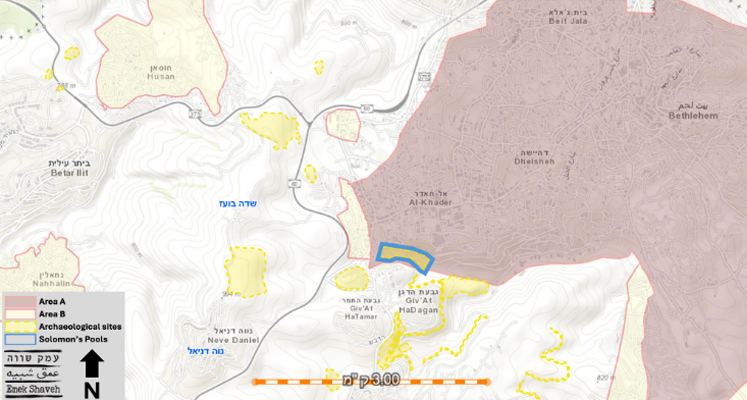
Solomon’s Pools in blue line
What began as a settler-led initiative has rapidly developed into an official political campaign. Senior ministers have entered the compound under military escort, called for it to be “returned to Israeli hands,” rejected the continued relevance of the distinction between Areas A, B and C, and announced plans for direct Israeli investment and the raising of the Israeli flag.
The campaign is now supported by a legal opinion from the Kohelet Policy Forum arguing that allegations of Palestinian damage or neglect allow Israel to suspend relevant provisions of the Oslo Accords and intervene directly at archaeological sites in Areas A and B. It is worth noting that the Kohelet Policy Forum’s legal opinion lacks a factual or legal basis that could enable the expropriation of the site as the authorities seek to do. Kohelet’s involvement is particularly concerning considering the major role it has played in promoting the coalition’s attempts at judicial reform.
It is important to note that in recent years, the Security Cabinet approved expanding the enforcement powers of the Staff Officer for Archaeology unit into Areas B and A in a move that violates the Interim Agreement between Israel and the Palestinian Authority. Although as of late May, the Cabinet’s decisions had not yet been implemented through a decree by the IDF’s Commander of the Central Command, it is possible that increased operations in locations such as Solomon’s Pools and Mt. Ebal, which aim to undermine the separation of powers between Israel and the Palestinian Authority, will expedite the process to implement the Cabinet’s decisions.
Together, these developments represent a dangerous new stage in the weaponizing of antiquities and cultural heritage as a pretext for extending Israeli authority into Palestinian-administered territory. A takeover of Solomon’s Pools would establish a precedent for intervention at hundreds of sites across Areas A and B and further dismantle the already weakened political and legal framework governing the West Bank.
Archaeological and Historical overview
Solomon’s Pools, known in Arabic as Burak Sulayman, consists of three monumental reservoirs forming part of the ancient water system that supplied Jerusalem, Bethlehem and the surrounding region. The compound lies between the Palestinian communities of Artas and al-Khader.
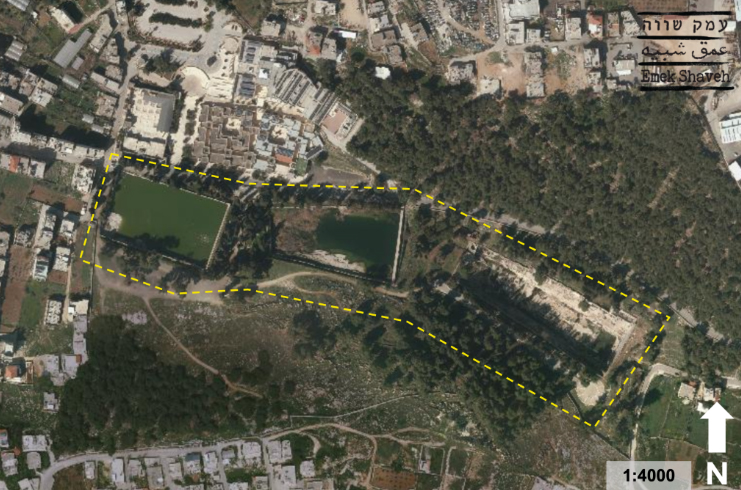
Solomon’s Pools in yellow line
Because they were continually filled with water, Solomon’s Pools were never thoroughly excavated. However, a post-1967 survey revealed they were the hub of a massive 70-kilometer water network dating back to the Early Roman period. The pools later underwent renovations in the Byzantine, Mamluk, and Ottoman periods.
The pools collected water from surrounding springs and aqueducts, channeling it to Jerusalem via the Upper Aqueduct (likely ending at Hezekiah’s Pool) and the Lower Aqueduct (flowing to the Temple Mount/Haram al-Sharif). Due to their continuous use over millennia, they are a multi-layered historical site shaped by countless successive cultures, including the Palestinians who live there today.
In modern times, the site has been a focus for both tourism and heritage preservation. During the Oslo Accords the site was designated as part of Area A and transferred to full Palestinian civil and security control. During the late 1990s Yasser Arafat planned to develop the pools into a major tourist and hotel complex as part of his “Bethlehem 2000” vision. Later, in 2009, the site’s advanced engineering earned it a spot on an initial inventory of 20 major Palestinian heritage sites compiled in cooperation with UNESCO. Despite this recognition, the pools were never advanced to the official tentative list of Palestinian World Heritage sites.
A coordinated political campaign
Despite the multicultural nature of the site, and the continuing plans made by the Palestinians to maintain the site and develop it as an important Palestinian heritage site, a series of high-profile Israeli visits that have taken place in recent weeks have attempted to portray Solomon’s Pools as a neglected site that Israel must take over in order to safeguard it from destruction. However, as demonstrated below, the main reason for this orchestrated campaign is the aspiration to lead to the cancellation of the Oslo Accords and promote steps for the annexation of the West Bank.
During a visit in May, Diaspora Affairs Minister Amichai Chikli declared that Israel must stop thinking in terms of Areas A, B and C. His statement explicitly connected the campaign over Solomon’s Pools to the broader objective of erasing the territorial distinctions established under Oslo.
On May 25, Finance Minister Bezalel Smotrich and members of the Religious Zionism Knesset faction entered the compound under military protection. MK Zvi Sukkot entered one of the pools, while participants called for the site’s transfer to Israeli control.
In late June, Minister and Security Cabinet member Ze’ev Elkin toured the site with Efrat Council head Dovi Shefler and stated that Solomon’s Pools must be “returned to Israeli hands.” Elkin claimed that its designation as Area A resulted from an error in the Oslo maps.
The campaign escalated last week on July 7, when Heritage Minister Amichai Eliyahu announced on Channel 14 that his ministry would allocate NIS 10 million to the site, take control of the compound and raise the Israeli flag. He claimed that the pools formed part of the ancient water system supplying Jerusalem and the Temple, adding:
“We are here as the victorious generation to tell you: you will not rewrite heritage, you will not harm our heritage sites, and you will not lay the foundation stone for a mosque that would destroy these pools.”
Eliyahu stated that the funding would be used to rehabilitate the compound, make it accessible and “strengthen the Jewish presence” at the site. It is worth recalling that a few months ago, Minister Eliyahu stood at another site, the Hasmonean Palaces near Jericho, and made it clear that anything built over Jewish heritage (whether real or imagined) would be destroyed by the State of Israel.
These declarations have been accompanied by military-backed settler incursions, restrictions on Palestinian access and government policies expanding Israeli enforcement into Areas A and B.
In a further escalation, according to Israeli and Palestinian reports, the military subsequently prevented Palestinian Prime Minister Mohammad Mustafa from reaching the compound and cancelled a Palestinian ceremony to lay the foundation stone for a planned mosque.
Military-backed incursions and the removal of Palestinians
On July 2, Emek Shaveh staff visited Artas and Solomon’s Pools and met the deputy head of the Artas Local Council, local residents and the director of the cultural centre responsible for managing the compound.
Their testimonies describe a significant change in Israeli practices since October 7, 2023, with a sharp escalation during the past three months. According to residents, Israeli forces now arrive before organised settler groups, establish checkpoints, close access roads and prevent Palestinian vehicles from approaching. Palestinian families and swimmers already inside the compound are ordered to leave, after which settlers are permitted to enter under military protection, including for ritual immersion.
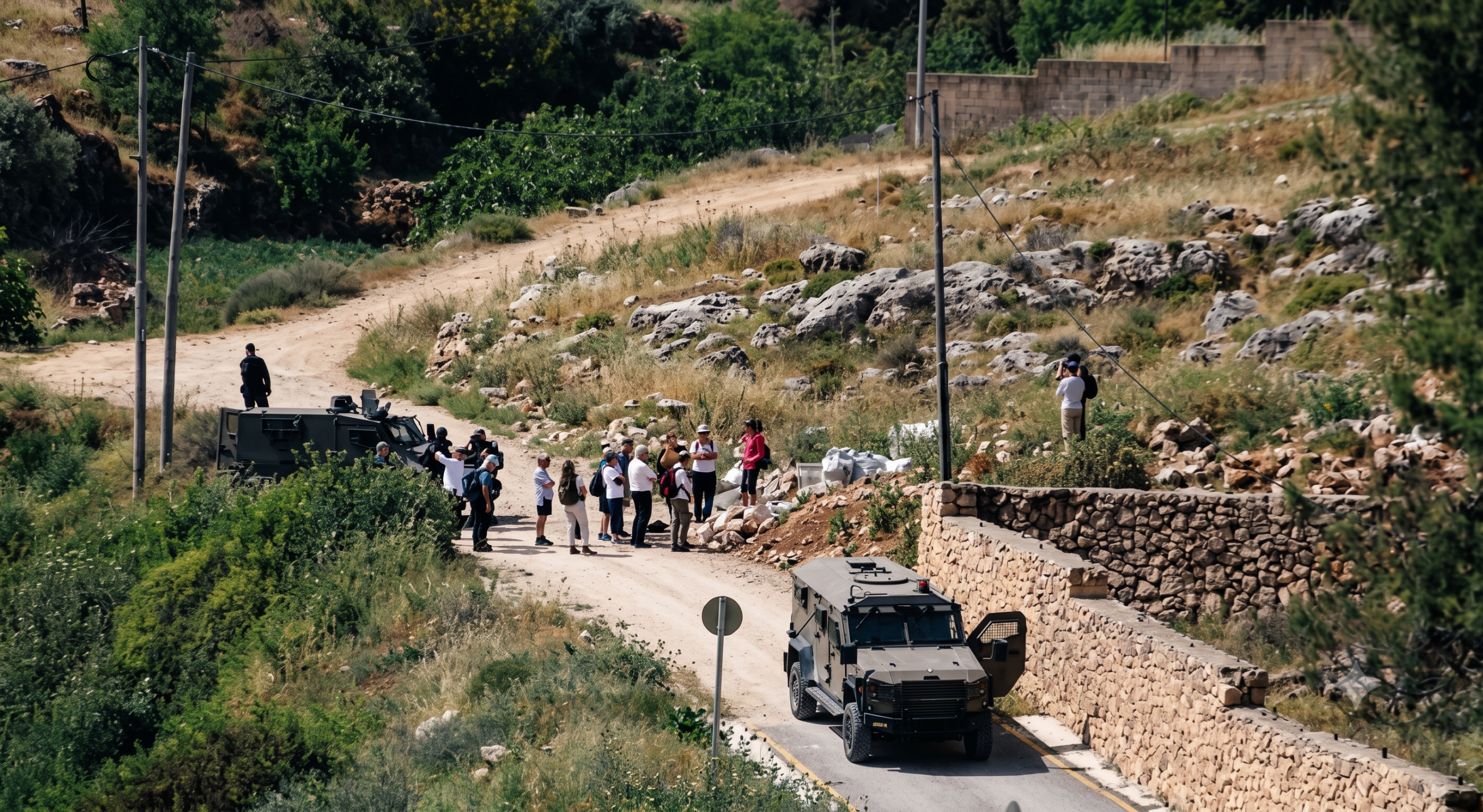
Israeli visitors en route to Solomon’s Pools as seen on Palestinian social media in recent weeks and (sharpened by AI by Emek Shaveh)
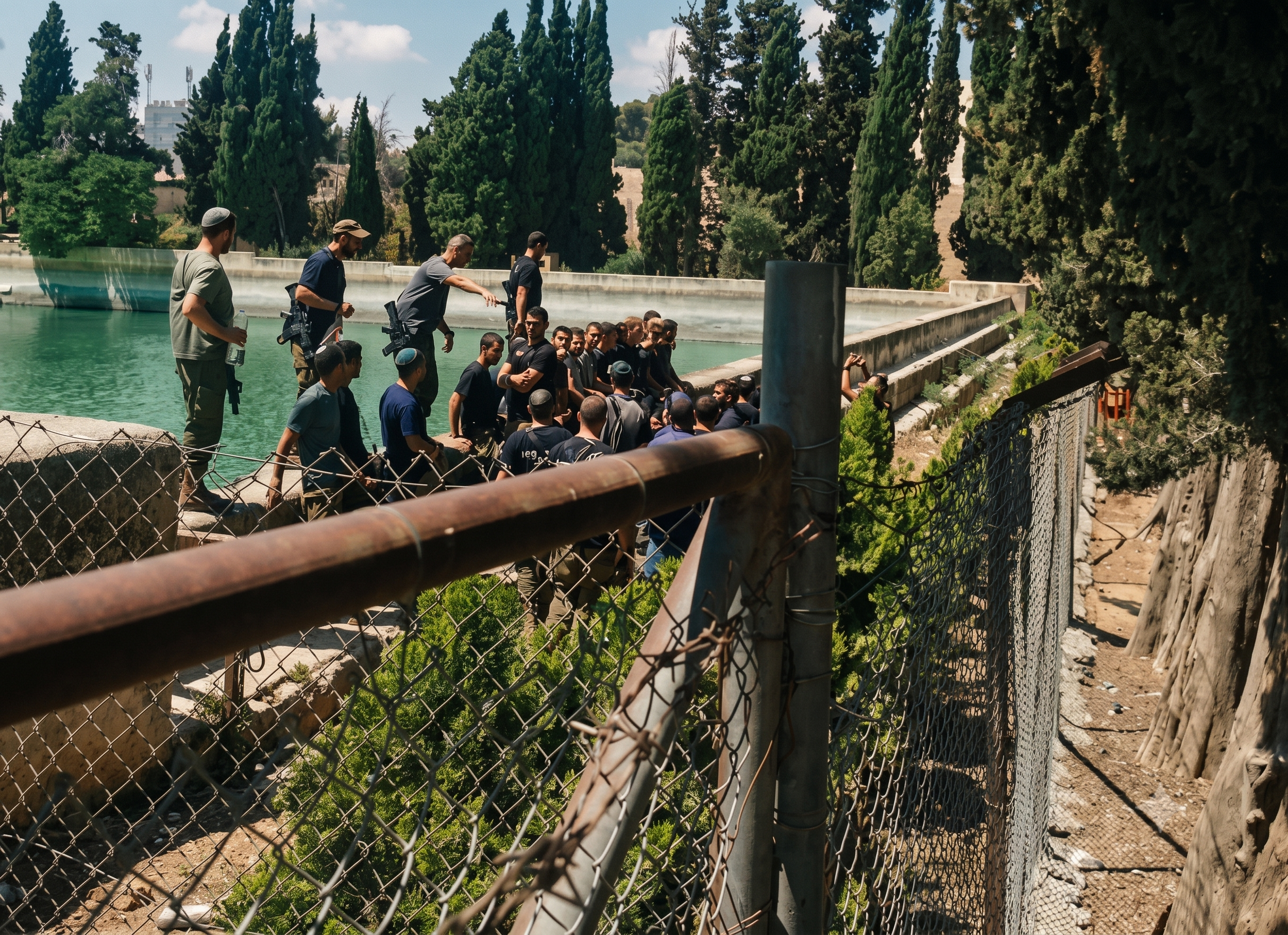
Israeli visitors at Solomon’s Pools in recent weeks as seen on Palestinian social media (sharpened by AI by Emek Shaveh)
These incursions have repeatedly generated violent confrontations. Residents described the use of stun grenades, tear gas and rubber-coated bullets.
Footage from June 26 shows Palestinian families caught amid stun grenades and tear gas during what had begun as a family outing. Images published on Palestinian social media show settlers entering the area under close military escort.
still from Bethlehem Community video on Telegram from 26.6.26 showing dispersal of Palestinians from Solomon’s Pools by the IDF using crowd control measures.
A living Palestinian heritage landscape
The compound of Solomon’s Pools is managed by a private Palestinian enterprise under a mandate from the Palestinian Authority. It includes a museum, cultural centre, convention facilities and an events hall. According to the site director, revenues are reinvested in maintenance and conservation. The compound has also benefited from international conservation funding and professional cooperation.
The pools and aqueducts are deeply connected to Artas. Until approximately thirty years ago, water flowing through the village was distributed among local families according to a traditional allocation system similar to that associated with Battir (ancient agricultural system which conferred on Battir the status of a World Heritage Site). Although domestic water now comes through modern infrastructure, the collective memory of this system remains central to the village’s identity.
Residents continue to maintain sections of the aqueduct through an annual communal project. A spring flowing through Artas remains essential to local agriculture, while the historic village mosque incorporates an Ayyubid dedicatory inscription into its walls.
This relationship has become particularly important during the current economic crisis. Following the revocation of Palestinian work permits in Israel and the withholding of Palestinian tax revenues, many Artas residents have returned to farming. Attempts to control the pools, water sources and surrounding land therefore threaten not only cultural rights but also the village economy and residents’ livelihoods.
Settlement expansion and pressure on Artas
The campaign is unfolding within a wider process of settlement expansion around Artas. Efrat has expanded substantially and now reaches the village’s outskirts. Residents report the loss of land through Civil Administration and military orders, together with growing pressure from nearby outposts.
The Eitam Farm, a shepherding outpost established on the hill above the village, has generated repeated confrontations with Palestinian farmers. Residents also report that settlers installed a gate blocking access to a nearby archaeological ruin, effectively reserving it for settlers.
Residents further state that land seized under the pretext of military necessity has been used to facilitate access from Efrat towards the Palestinian road leading to Solomon’s Pools. This infrastructure makes future Israeli entry into the compound easier and indicates that the ministerial campaign is supported by physical preparations already underway.
The Kohelet opinion: a doctrine for intervention under the guise of a legal opinion
Last week, July 8, the Kohelet Policy Forum published a legal opinion entitled The Authority of the State of Israel to Prevent Damage to Archaeological Sites in Areas A and B. Written specifically in relation to Solomon’s Pools upon request by the right-wing NGO “Guardians of Eternity”, it argues that the Palestinian Authority’s alleged plan to build a mosque at the site, together with its purported failure to protect archaeological remains, constitutes a material breach of its obligations under the Oslo Accords.
Kohelet therefore claims that Israel may suspend the relevant provisions of the agreements and exercise at Solomon’s Pools the same enforcement and conservation powers it uses in Area C. The opinion goes further, suggesting that Israel may have a positive obligation to intervene because it has exercised overall control since 1967, claims sovereign rights throughout the territory and bears responsibilities under international cultural-property law.
The opinion repeatedly relies on information presented to its authors and an alleged intention to construct a mosque directly over archaeological remains. It does not consider the compound’s existing Palestinian management, broader development and conservation plans, previous international restoration projects or mechanisms for professional cooperation.
The opinion also distorts international law. An occupying power’s obligation to safeguard heritage does not confer sovereignty, permit appropriation or authorise the displacement of competent local institutions. International law requires the occupying power, as far as possible, to support the local authorities responsible for protecting cultural property and not replace them or use conservation as a basis for territorial control.
The implications extend far beyond Solomon’s Pools. If an allegation of neglect or prospective damage is sufficient to suspend Palestinian authority at one site, the same reasoning could be applied to hundreds of archaeological and religious sites throughout Areas A and B.
An urgent need for intervention
A forced Israeli takeover of Solomon’s Pools would violate Palestinian cultural, property and governance rights and establish a precedent for similar action across Areas A and B.
Emek Shaveh urges the local archaeological community, the international community and like minded organisations to:
- Demand that Israel refrain from unilateral expropriation, construction, flag installation or conservation work at Solomon’s Pools and other historical sites in the oPt.
- Call for an immediate end to military-backed settler incursions and restrictions on Palestinian access.
- Support conservation led by the Palestinian authorities, the existing site-management body and the communities of Artas and al-Khader, with independent international professional assistance.
- Reject the claim that alleged conservation failures permit Israel to suspend Palestinian authority or extend its powers into Area A.
- Make clear that cultural heritage cannot be used to dismantle the remaining territorial and legal framework in the West Bank.
Solomon’s Pools is not an abandoned archaeological site awaiting Israeli rescue. It is a living Palestinian cultural landscape maintained by local institutions and communities whose history, economy and identity are inseparable from it.
Without immediate international intervention, it risks becoming a precedent for erasing the distinction between Areas A, B and C and using archaeology and cultural heritage to advance direct Israeli control throughout the West Bank.