
Army issues seizure order for strip of land leading to Hasmonean Palaces (Tulul Abu el-‘Alayiq) near the the Bedouin community of A-Steh (Ein ad-Duyuk al Tahta), on the western outskirts of Jericho
24.6.2026
Note: This report was written jointly by Dror Etkes, founder of Kerem Navot*, Dr. Yael Sela, Palestine Solidarity Co-op** and Emek Shaveh ***
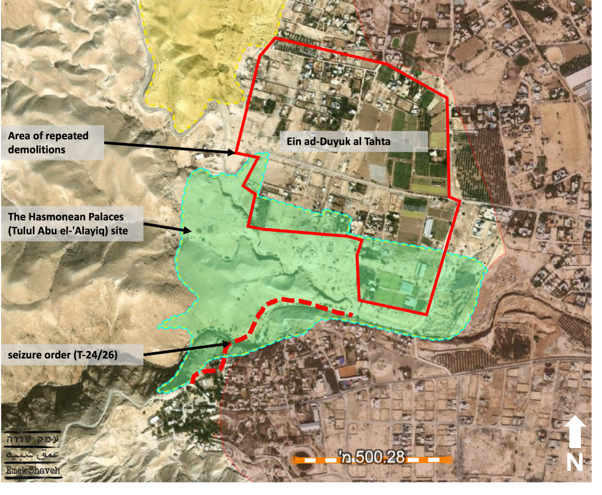
In March 2026, the Israeli military issued a seizure order (T-24/26) for a strip of land leading to the archaeological mound known as the Hasmonean Palaces on the western outskirts of Jericho (within Area C). The route of the seizure order, as published, will create an access route to the archaeological site that bypasses Jericho (Area A). The order, signed by Major General Avi Blut, head of the IDF central command, on March 30, 2026, was handed to residents affected by it only on April 21.
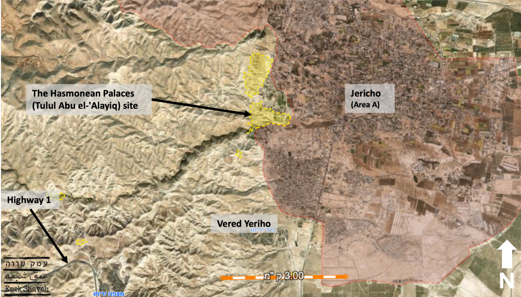
The Hasmonean Palaces (Tulul Abu el-‘Alayiq) site is located on the outskirts of Jericho (241065/640048). The site contains remains of the winter palaces of the Hasmonean and Herodian Kingdoms from the 2nd – 1st centuries BCE. It is situated meters away from the Kaabneh Bedouin community of Ein ad-Duyuk al Tahta. In recent months the community has been the victim of daily settler violence and harassment.
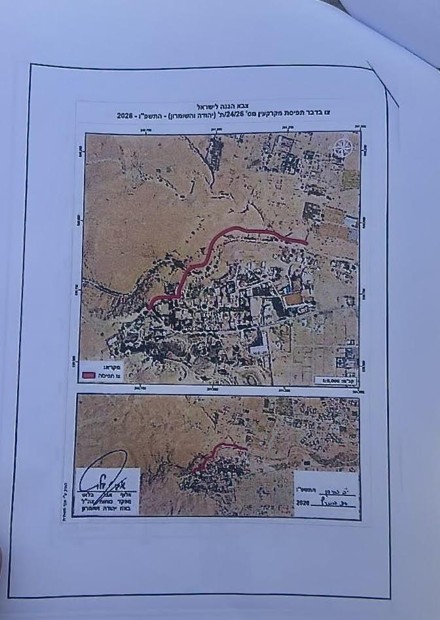
Route of seizure order (in red) as marked on the Israeli military map attached to the order
Attacks on the community began on February 10, 2026, with an eight-hour pogrom carried out by dozens of settlers that included physical violence against women and children of the community, the theft of agricultural vehicles, cash, and personal valuables, as well as the demolition of thirteen homes using a bulldozer. Throughout the pogrom, residents’ distress calls to Israeli police and Palestinian and Israeli DCOs were entirely ignored, allowing the demolitions to continue. According to residents, the bulldozer came from the nearby outpost known as Armonot Farm, erected in the summer of 2024 and run by Hanan Herbst (the outpost was approved as a full-fledged settlement under the name Daya on April 1, 2026).
While some of the houses had pending demolition orders, an interim injunction issued by the High Court was supposed to protect them. Needless to say, either way, demolition orders are to be carried out by the Civil Administration (ICA); but demolition by settlers is an entirely new development in the West Bank. The ICA later confirmed that they had not ordered the demolitions. By the end of the pogrom, the settlers had warned residents that if they returned, their houses would be burnt to the ground, and proceeded to plow up land inside the community. Among the attackers was Micha Sudai, who was documented unmasked. Sudai is owner of “Micha’s Farm” (officially approved as “Yitav West” on April 1, 2026, and also known as “Rosh Tidhar”), and is a leading Jewish settler known for terrorizing Palestinian communities in the southern Jordan Valley and suspected as one of the leaders of the expulsion of Ras Ein al-Auja in January 2026.
It is worth noting that on the morning of the pogrom (February 10, 2026), the Minister of Heritage Amihai Eliyahu uploaded a facebook post where he is seen visiting the Hasmonean Palaces and saying “Every place that is built on the heritage of the Jewish people we will destroy it”.
Currently, members of the community live without shelter or in the ruins of their own homes, as plans to develop the site, just a few meters away, as a lucrative settler-run tourist attraction are moving ahead.
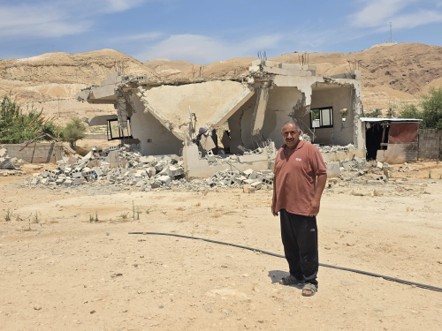
Yusuf Abu Ali in front of his home destroyed by settlers. Photo: Emek Shaveh, June 2026
Within the Oslo Accords, which divided responsibility for archaeological sites between the Palestinian Authority in Areas A and B and the ICA’s Staff Officer for Archaeology (SOA) in Area C, Article 9 of Annex III identified twelve sites of “archaeological and historical importance to the Israeli side,” including the Hasmonean Palaces which, according to the accords, would eventually come under Palestinians control and would be subject to a joint Palestinian-Israeli professional committee. That committee was never convened.
The Hasmonean Palaces are also one of several major antiquity sites that the current Minister of Heritage, Amihai Eliyahu, had defined as “anchor sites” in the plan to develop Judeo-centric archaeological theme parks across the West Bank. In July 2023, the government had allocated 20 million NIS for the development of the site into a tourist attraction. At the time it was said that the Binyamin Regional Council would operate the site. The community of Ein ad-Duyuk al-Tahta is situated in part on what Israel considers state land and in part on land privately owned by East Jerusalemite families. The area under seizure order is privately owned, but as of June 2026, the owners have not yet been located.
In recent years, a settler-led campaign, spearheaded by the NGO Guardians of Eternity, claimed deliberate destruction of “Jewish” antiquities by the Palestinians, in an attempt to push the government to expand control over West Bank sites. The Hasmonean Palaces site was often mentioned in this context. Over the years, the SOA has carried out numerous enforcement actions at the site, including stopping works, confiscating equipment, and demolishing what it defines as illegal construction.
Use of military seizure orders on the rise
Military seizure orders are ostensibly temporary, and the land they cover may, in principle, be used only for urgent security purposes. However, the concept of “security needs” is subordinated first and foremost to the interests of the settlement enterprise.
Recent years have seen a sharp increase in the number of seizure orders that have been issued by the military. Between 2023 and 2025, the military issued at least 140 seizure orders, under which about 3,370 dunams were seized. Of the 140 orders reviewed, 113 (about 81 percent) were issued to serve settlers’ interests – mainly for protecting settlements and illegal outposts. Another seizure order linked to development plans for an antiquity site was issued for the sumit of Sebastia in July 2024.
| Year | Number of seizure orders | Area of seizure orders (dunams) |
| 2023 | 25 | 450 |
| 2024 | 32 | 300 |
| 2025 | 83 | 2,620 |
As for 2026, we do not yet have the full data needed to present a full comprehensive picture of the seizure orders issued, though it seems that the trends are similar to ones we have seen in the last few years. Seizure order T-24/26 is an obvious example for an order that was issued to serve settler interests, rather than what can be described as “urgent security purposes”.
——-
* Kerem Navot is an Israeli NGO that monitors and researches Israeli land policy and settlement expansion in the West Bank. Dror Etkes, detkes@gmail.com, and 054-489-9351
**The Palestine Solidarity Co-op is an egalitarian cooperative of Israeli, Palestinian, and international activism groups committed to providing Palestinian communities with protective presence as well as facilitating and coordinating legal and humanitarian support. Yael Sela, yaelsela.teichler@gmail.com, 058-5151850 (WhatsApp)
*** Emek Shaveh is an Israeli NGO founded by archaeologists who monitor and oppose the exploitation of archaeology to advance settlements and annexation and advocate for the principle that antiquity sites are the shared cultural heritage of all those who have roots in this land. Talya Ezrahi, talya@emekshaveh.org, 054-5981865