
Urgent: Following Knesset committee discussion, Annexationist Bill Disguised as Antiquities Protection set to be finalized next week ahead of vote
On Wednesday, 31 December 2025, the Knesset’s Education, Culture and Sports Committee, chaired by MK Zvi Sukkot (Religious Zionism), held its fourth discussion on legislation that would extend Israeli civilian jurisdiction over antiquities and heritage sites in the West Bank. The discussion follows the ministerial committee’s approval to advance the law and a preliminary Knesset vote in July 2024 and comes ahead of a first vote in the Knesset plenum.
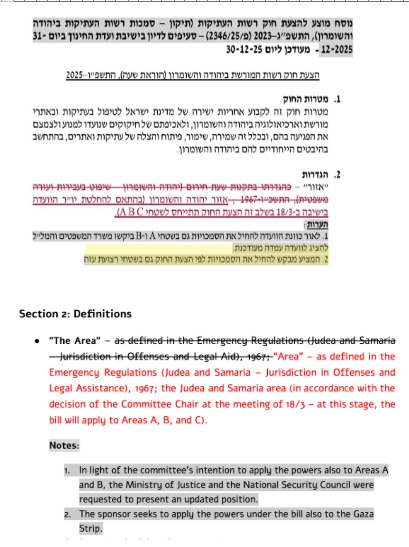
The latest version of the bill, published on the eve of the committee meeting, explicitly extends its scope to Areas A and B, in addition to Area C. A new accompanying note further indicates that the bill’s initiator, MK Amit Halevi (Likud), seeks to apply the same framework to the Gaza Strip. These changes remove any remaining doubt as to the bill’s purpose: it is not a heritage-protection measure, but a legal and administrative test case for extending Israeli civilian governance—and ultimately sovereignty—over the entirety of the occupied Palestinian territory.
If voted into law, it would violate international law, fundamentally breach the Oslo Accords, and directly contradict stated European Union and United States policy opposing annexation.
The committee is scheduled to reconvene on Tuesday, 6 January 2026 at 13:00, beginning with a closed-door session followed by an open-ended meeting intended to finalize the bill ahead of its first plenum vote. The pace and procedure indicate a clear determination by Halevi and his coalition partners to advance the legislation rapidly.
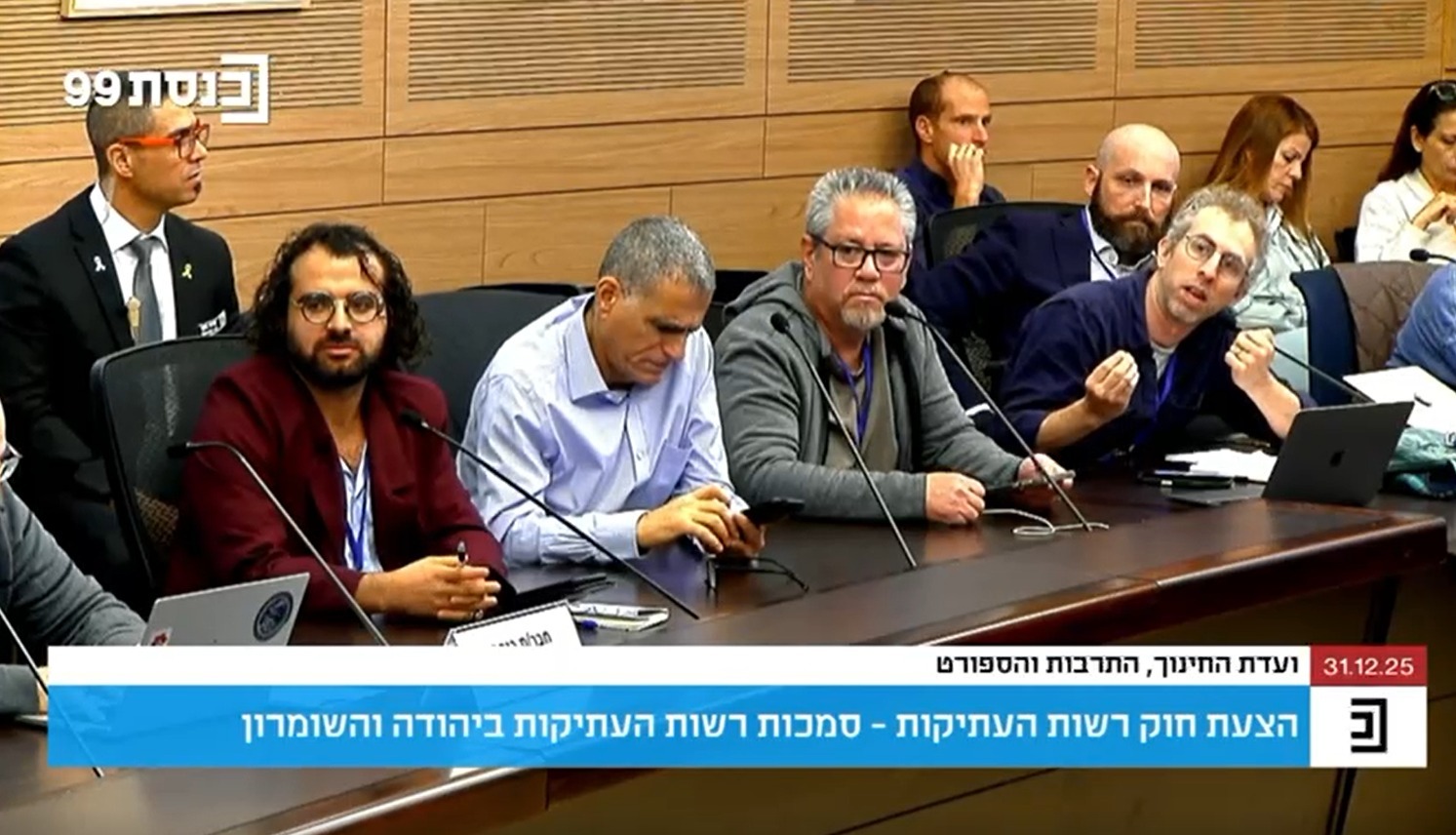
From right to left: Emek Shaveh ED Alon Arad and Spokesperson Uri Erlich, Former MK Mossi Raz and Uri Hada from the new initiative “Archaeology Students Against the Occupation” at the Knesset committee session on 31st of December.
In detail:
Wednesday’s (December 31st) committee session was convened under the new chairman Zvi Sukkot of the Religious Zionism party. In attendance amongst other central actors were, Amichai Eliyahu, Minister of Heritage from Jewish Power, and the bill’s initiator, Amit Halevi of Likud. The only voice from the opposition was MK Gilad Kariv, who described the bill as “delusional” as it is part of a “creeping annexation, undermining of Israel’s international security”, and uses archaeology “as a tool for taking over land and expelling Palestinians from their homes” and “an abuse of archaeology and scientific research.” In addition, MK Kariv mentioned that the process of legislation is exceeding the committee’s mandate as the new version of the law is in fact a completely new piece of legislation and would need to undergo a preliminary process.
The latest version of the law was published just before the discussion with the most recent changes displayed in mark-up (see translated excerpt below). As mentioned above in the suggested changes to the version of the legislation tabled last March, the proposal now seeks to change the term from “Area” to the “Judea and Samaria area” and states that the bill will apply to Areas A, B, and C. The note on applying the bill to the Gaza strip was also added just recently. See section 2 of the latest version of the bill (original Hebrew and translated excerpt) below.
It is important to note that the original version of the bill submitted to, and approved by, the Ministerial Committee on Legislation in July 2024 and which had passed a preliminary reading, sought to apply the Israeli Antiquities Law to the West Bank and authorize the Israel Antiquities Authority (IAA) to operate there. That version of the bill had been met with sweeping opposition in all the previous committee sessions (27 November 2024, 11 February 2025, and 18 March 2025), from all the central professional bodies in the field of archaeology who cited the potential damage the law would bring to the international standing of Israel’s archaeologists. These include the Israel Antiquities Authority, the Council of the Israel Antiquities Authority, the Archaeological Council, the Forum of Heads of Archaeological Institutes, the Israel Archaeological Association, and the Israel Academy of Sciences and Humanities. Following this, last March Halevi backed down. That retreat gave rise to the current proposal, which in place of extending the jurisdiction of the IAA seeks instead to establish another civilian administrative body specifically for the West Bank under the Ministry of Heritage which would replace the Staff Officer for Archaeology (SOA) within the Israeli Civil Administration (ICA).
The current iteration of the law remains equally incompatible with international law, insofar as it extends Israeli civilian law to occupied territory and empowers a civilian authority to administer antiquities sites there.
In addition, the current version of the bill is, as mentioned above, being advanced through a highly irregular and legally questionable process. It constitutes an entirely new proposal, materially different from the bill originally submitted in 2024, yet is being brought to a first vote without undergoing a preliminary vote or receiving approval from the Ministerial Committee for Legislation.
In addition to this procedural flaw, the new law being promoted in the committee exceeds the mandate granted to it by the Government, in that the decision of the Ministerial Committee for Legislative Affairs stated (Section B): “Following the preliminary reading, the draft of the bill shall be amended so as not to imply a change in the status of the territory, and it shall be promoted subject to Israel’s international obligations.”.
The fact that the law will create a reality of annexation has been repeatedly highlighted during committee discussions by legal advisers from the Ministry of Justice, mentioning that the bill’s explicit extension to Areas A and B directly contravenes Section B by altering the status of the Area and that the law’s advancement should abide by Israel’s international obligations.
The Minister of Heritage Amihai Eliyahu said at Wednesday’s session that the latest version of the bill was a compromise and an interim step until such time as full sovereignty can be achieved:
“I genuinely think that the heritage areas in Judea and Samaria are the lands of the Jewish people, if only from the standpoint of historical truth. On top of that, there is a system here that is taking responsibility. We want to entrench it for generations and preserve the heritage…Therefore, our way of addressing this is to establish—putting it politely and fully, as Member of Knesset Amit Halevi says—that the State of Israel must take responsibility for this as an interim step. And here I also say to Beni (Har-Even the Staff Officer for Archaeology): as an interim step, we are prepared for the authority to operate for now within the proposed framework put forward by the legal adviser, as proposed in the draft, as recommended by the professional bodies—an interim stage until full sovereignty is actually applied.”
Implications:
The bill effectively applies Israeli sovereignty to sites in occupied territory under the guise of antiquities legislation.
The application of a civilian mechanism operating by virtue of Israeli law in the territory of the West Bank undermines the principle of temporariness and violates the laws of occupation, it contravenes the Oslo Accords (under which the PA assumes responsibility for antiquities in Areas A and B, while area C was slated to be gradually transferred also to the PA’s responsibility) and is a violation of the 1954 Hague Convention and its first protocol to which Israel is a signatory (in addition to the violation of multiple other conventions such as the 1907 Hague Regulations, the Fourth Geneva Convention of 1949, the ICESCR and ICCPR 1966, the ICJ advisory opinion 2024).
The legislation has no professional merit. On the contrary, adoption of the bill would result in chaos in the management of heritage sites and is advanced despite the wide consensus among professionals who warned that in addition to the bureaucratic chaos, its adoption would lead to the isolation of the Israeli archaeological community and ultimately to its collapse. At the last session, there was even mention of the possibility of arrests of Israeli archaeologists, bringing as an example the legal case against Russian archaeologist, Alexander Butyagin.
It is important to remember that the bill is first and foremost an assault against the Palestinian people and the communities living in or near antiquities sites who consider these sites part of their collective cultural heritage and a central component of their identities. It is a violation of their cultural rights and will deal a irreparable blow to the viability of a Palestinian state. The bill will also inevitably harm the State of Israel, its foreign relations, academic and cultural partnerships, and its political horizons. The only objective of this proposal is to use archaeology as a “vanguard force” tasked with pathing the way for extreme messianic visions leading to the annexation of the West Bank, regardless of the consequences.
Recommendations:
- Treat the bill as tantamount to annexation of occupied land and as a clear and immediate danger to the two-state solution.
- Remind Israel of its obligations under international law, treaties and agreements to which Israel is a party of and therefore:
- Reject any attempt to apply Israeli civilian governance to West Bank territory.
- Remind Israel of its commitment under the Oslo Accords to:
- Respect and allow the PA to govern antiquities in areas A and B without disturbances.
- To
- safeguard and protect antiquities sites in Area C for the benefit of occupied peoples
- To promote the cooperation with the Palestinian authorities and its academic institutions.
- Cease any academic archaeological projects and other illegal archaeological initiatives such as touristic development in the West Bank, and the illegal transporting of archaeological finds out of the West Bank.
- Demand that Israeli authorities and academic institutions maintain complete transparency in handling antiquities in the oPt, and consider any actions outside those permitted by international law as non-legitimate academic activities.