
Sebastia: Updated Position Paper on the Threat of Expropriation, Appropriation and Annexation
Note: This is an updated version with details of the recent expropriation order issued by the Israeli Civil Administration for the entire site of Sebastia which requires immediate attention.
Executive Summary
Sebastia, which has been included since 2012 on the UNESCO Tentative List of World Heritage Sites for the State of Palestine, is one of the region’s most important ancient cities and cultural landscapes. In an alarming development, the Israeli Civil Administration issued on 11th February 2026 a second expropriation notice for the entire site of Sebastia and its surrounding area, a total of 1800 dunams, including privately owned land belonging to residents of Sebastia and the neighbouring village of Burka. This latest order follows on an initial notice of intention to expropriate issued in November. The initial objections submitted by the residents following the notice of intent in November were rejected.
Sebastia is a multilayered archaeological mound that spans millennia and a historic town situated in the northern West Bank near Nablus. Excavations since the early 20th century have revealed a continuum of diverse cultures and peoples. The site has been associated with the Iron Age Shomron/Samaria capital of the Israelite Kingdom, a Roman city built by Herod and named after Augustus (Sebaste), and the burial place of John the Baptist, marked by a Crusader cathedral later converted into the Nabi Yahya mosque.
Since 1967, Israel’s actions at archaeological sites in the West Bank have been characterized by exclusion of Palestinian communities, development of settler-led tourism, and systematic violations of international law. Over the past six years, Israeli governmental bodies and settler organizations have intensified efforts to sever Sebastia’s acropolis (Area C) from the historic town (Area B), undermining local conservation, restricting access, expanding militarisation, and privileging a single historical layer.
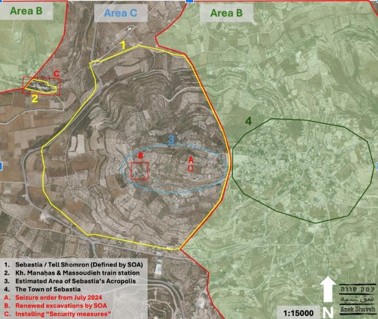
Map of Sebastia site and historic town divided into Areas B and C
In May 2023, the Israeli government approved Government Plan no. 491, allocating 32 million NIS to develop what it now calls the ‘Shomron National Park.’ In 2024 the military issued a seizure order for the summit of the site and in May 2025, the Israeli Ministry of Heritage commenced new excavations at the site.
The most drastic development occurred on November 19th 2025[1], when the Israeli Civil Administration (ICA) published its intention to expropriate the entire archaeological acropolis of Sebastia and a vast surrounding area, a total of 1800 dunams, including privately owned land belonging to residents of Sebastia and the neighbouring village of Burka. This measure aims to detach the archaeological site from the town, reroute access directly to Road 60, and establish a settler-managed tourist site—ending centuries of cultural continuity and destroying Palestinian-led tourism, the main economic lifeline for the community.
In February 2026, the residents of Sebastia received notification from the ICA that their initial objections to the expropriation order were rejected and a second more definitive expropriation order was issued. We at Emek Shaveh have still not received a response to our objection to the expropriations.
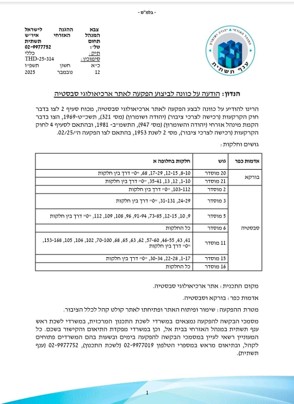
Notification of intention to expropriate land for the purpose of “preservation and development of the site” as it appeared in Hebrew on the Civil Administration’s website.
These cumulative actions at Sebastia coincide with mass site declarations in the northern West Bank, expansion of Staff Officer for Archaeology (SOA) authority into Area B and A, and efforts to extend Israeli antiquities law into the West Bank and are advancing the cause of the illegal annexation of land including historic sites. These constitute violations of the 1954 Hague Convention and its protocols, contradict the 2024 Advisory Opinion of the International Court of Justice, and undermine multiple UN resolutions concerning cultural property in occupied territories including the latest Independent International Commission of Inquiry on the Occupied Palestinian Territories (see paragraph 64 on Sebastia).
Israel’s current policies represent a coordinated strategy of weaponising archaeology for purposes of land appropriation, cultural erasure, and annexation. Given the severity of the threat, we feel it would be imperative that an emergency inscription process is initiated for Sebastia to provide international oversight, and call on Israel to rescind the expropriation and other unilateral activities at the site notice.
Recent developments in detail:
Since 1967 the Israeli Right has used ancient sites to justify the settlement project in East Jerusalem and the Occupied West Bank. Beginning in 2019, Jewish settler organisations operating in the West Bank have advanced multiple plans for transforming key archaeological sites into settler-run tourist anchors. These initiatives were accompanied by a misleading public campaign alleging that Palestinians were engaged in widespread destruction of Jewish antiquities. Sebastia quickly became the flagship site within this effort due to its historical significance and strategic location.
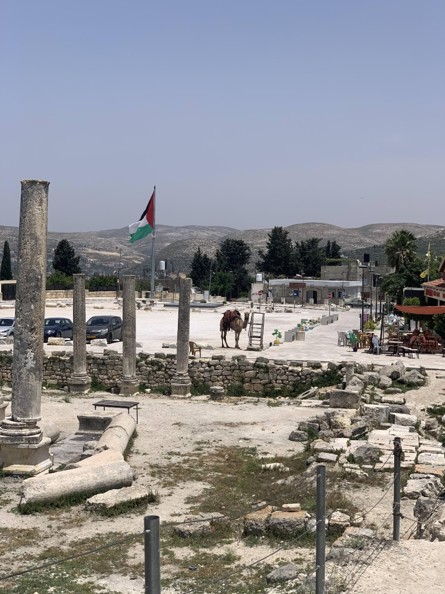
Site of Sebastia with the PA’s Ministry of Tourism’s Visitors’ Centre in background
In May 2023, the Israeli government approved Government Decision 491, allocating 32 million NIS for the development of what Tel Sebastia into a major tourist attraction. The explanatory notes accused the Palestinian Authority of advancing ‘illegal and destructive actions’ at the site. In July 2023, a further 120 million NIS was allocated for the development of archaeological sites across the West Bank, reflecting a dramatic shift in national heritage spending priorities toward occupied territory and in October 2025 another 40 million NIS.
In June 2024, the Israeli cabinet authorised the Civil Administration’s Staff Officer for Archaeology (SOA) to implement heritage-related actions in Area B—contravening the Oslo II Interim Accords, which stipulate that civilian governance in Area B, including archaeology, falls under the Palestinian Authority. In February 2026, another cabinet decision authorized the SOA to take enforcement measures at sites in Area A as well. In parallel, a bill advanced in the Knesset during 2024–2026 seeks to replace the SOA with a civilian authority under the Ministry of Heritage, effectively extending Israeli antiquities law into the West Bank. If enacted, this would constitute de jure annexation of heritage governance.
On 10 July 2024, the Israeli military issued a seizure order for 1.3 dunams at the summit of the Sebastia mound, enabling the installation of a surveillance pole at the highest point of the archaeological site. Despite objections submitted by local landowners, the Municipality of Sebastia, and Emek Shaveh, the military legal advisor rejected the appeal in May 2025.
In May 2025, the Ministry of Heritage announced the commencement of new excavations in Sebastia, led by the SOA. These activities proceeded without coordination with, or consent from, the competent Palestinian authorities.
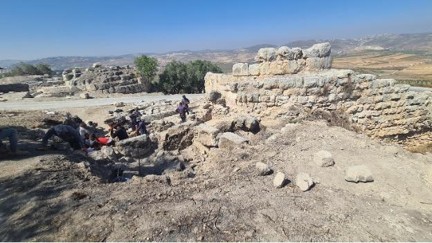
SOA excavations at Sebastia, June 2025
In August 2025, the Civil Administration distributed sixty site declarations across the northern West Bank—the largest such wave of declarations ever recorded. Thirty of these were newly designated sites, dramatically expanding Israeli control over heritage landscapes in Area C.
The most consequential step for Sebastia occurred in late 2025, when the Municipality of Sebastia received an official notification of the Israeli Civil Administration’s intention to expropriate the entire archaeological acropolis of Sebastia, along with significant surrounding areas including privately owned land belonging to residents of Sebastia and the nearby village of Burka. The confiscation notice covers all open archaeological areas, historic features, access routes, and agricultural plots within Area C. Its stated goals—including linking the site directly to Road 60 and developing a national park—are aimed at severing Sebastia’s centuries-old cultural and economic ties between the town and its archaeological heritage.
In addition, on November 25th, the Israeli authorities began fencing in the nearby site of Massoudieh, the Ottoman era train station near Sebastiya for which the Israeli government allocated 3.5 million NIS for fencing and reconstruction.
Archaeological Sites in Conflict Areas According to International Law
International law establishes clear obligations concerning the treatment of cultural heritage in occupied territories. Sebastia, located within the occupied Palestinian territory, is protected under multiple legal frameworks which prohibit excavation, appropriation, alteration, or development of archaeological sites for tourism without the consent of the local population and competent national authorities—in this case, the Palestinian Authority’s Ministry of Tourism and Antiquities.
The 1954 Hague Convention for the Protection of Cultural Property in the Event of Armed Conflict, to which Israel is a signatory, obliges an occupying power to safeguard cultural heritage and to support the competent local authorities in ensuring its protection. The First Protocol of the Convention further prohibits the removal or retention of cultural property from occupied territory. The New Delhi Recommendations of 1956 likewise stress that archaeological sites may not be excavated or developed by an occupying power except in close coordination with local authorities.
Although Israel has not ratified the Second Protocol to the 1954 Hague Convention, the Palestinian Authority has. Its core principles include the prohibition on illicit excavations or alterations by an occupying power except when strictly required for conservation and in cooperation with the competent local authorities. The unilateral excavations initiated by the Israeli Staff Officer for Archaeology at Sebastia in May 2025 and the current expropriation order and the plan to develop Sebastia as an Israeli-run tourist attraction while severing it from its historic and human context is a flagrant contradiction of Israel’s obligations under international law.
The UN Independent International Commission of Inquiry on the Occupied Palestinian Territory, including East Jerusalem and Israel, recently determined that Israeli excavations and development works at Sebastia are illegal under international law, amounting to misappropriation of cultural heritage (see clauses 64 and 93). Misappropriation of cultural property belonging to a people is explicitly prohibited under rule #40 of customary IHL and rooted in Article 4 of the 1954 the Hague Convention.
The 2024 Advisory Opinion of the International Court of Justice reaffirmed Israel’s obligation to comply fully with international humanitarian and human rights law in the Occupied Palestinian Territory. The Court stressed that all settlement activities – including those involving cultural heritage – are unlawful and must be reversed. The ICJ also underscored the protection of cultural heritage as part of the rights of occupied populations.
Israel’s recent measures at Sebastia, including military seizure orders, the extension of SOA jurisdiction into Area B and A, mass site declarations, legislative steps to impose Israeli antiquities law in the West Bank, new excavations, and now the confiscation of the entire acropolis and sever it from the town constitute violations of these binding norms. These steps transform archaeology into a mechanism of control, erasure, and annexation. The integrity and authenticity of Sebastia – as well as the cultural rights of the local community – are therefore at immediate risk.
Historical, Archaeological, and Cultural Background
Sebastia is one of the most significant multi-layered archaeological and cultural landscapes in the region. The site reflects over three millennia of continuous human settlement, political change, religious traditions, and architectural development. Its unique stratigraphy and well-preserved remains illustrate the complex interactions among ancient cultures and empires, making it a site of exceptional value for understanding the region’s history.
During the Iron Age, the site – known as Samaria – served as the capital of the northern Kingdom of Israel under the Omride dynasty. Excavations conducted by the Harvard Expedition in the early 20th century revealed substantial remains from this period, including portions of the royal citadel, administrative buildings, fortifications, and possible royal tombs. The city was destroyed by the Assyrians in 721 BCE but continued to function as an administrative centre into the Persian period.
Sebastia underwent major expansion during the Hellenistic and Roman periods. During the 1st Century BCE, the city was rebuilt by king Herod. He renamed it “Sebaste”, in honor of Augustus (Sebaste was Augustus’ Greek name). Excavations at the site yielded remains of substantial construction projects. Among other structures, Herod built a temple, theatre, and a stadium.
During the Byzantine period, a church was built on the acropolis marking the site at where, according to tradition, John the Baptist was executed. A church built to the east of the acropolis (in the present-day town) commemorated the location which Christians believe is the site where his body was buried. The churches were in use for centuries. The church situated in today’s town of Sebastia was destroyed by an earthquake in the 8th century and rebuilt during the Crusader period as a cathedral. The church on the acropolis was also renovated following the capture of the site by the Crusaders in 1099. Excavations, conducted along the columned street dating to the Roman period, uncovered remains of domestic buildings as well as a glass factory.
After the Crusader conquest in 1099, the basilica in the town was rebuilt as a cathedral, and the acropolis church was renovated. When Saladin reconquered the region in 1187, the cathedral was converted into the Nabi Yahya mosque, which continues to serve as the principal mosque of Sebastia. Pilgrims’ accounts from the 17th century document Muslim and Christian worshippers frequenting the site together, reflecting centuries of shared religious reverence.
During the Ottoman period, Sebastia became one of Palestine’s notable ‘Throne Villages’—a network of rural political centres governed by local notable families. Qasr al-Kayed, the seat of the village’s governor, still stands as an impressive example of Ottoman architecture. In 2013, Sebastia and twelve other Throne Villages were added to the UNESCO Tentative List of World Heritage Sites due to their significance as centres of local governance and cultural identity.
The modern town of Sebastia grew around the archaeological remains, integrating historic buildings, agricultural terraces, and pathways that have survived for centuries. The landscape is therefore inseparable: The tel and the town form a single, living cultural environment. Local traditions, livelihoods, and identity are deeply connected to the archaeological remains, which have served as sources of economic stability through tourism and heritage-related employment.
The destruction of this continuity—through confiscation, severance of access, militarisation, or unilateral development—would irreparably damage the integrity and authenticity of one of the most important archaeological sites in historic Palestine.
Developments at Sebastia Since 1967
Following Israel’s occupation of the West Bank in 1967, Sebastia became an early focal point for Israeli archaeological, military, and settler activity. The site’s historical significance, combined with its strategic position northwest of Nablus, made it one of the first locations where cultural heritage was mobilised to assert territorial claims.
In 1970, Israel declared approximately 700 dunams of Sebastia’s archaeological zone as a national park, named ‘Ancient Shomron.’ This declaration was based on an unrealised plan from the British Mandate era but was repurposed by Israeli authorities to formalise control over the acropolis. The park was placed under the joint authority of the Civil Administration’s Staff Officer for Nature Reserves and National Parks and the Staff Officer for Archaeology (SOA). The designation excluded the Palestinian town situated directly adjacent to the site, thereby creating an artificial separation between the tel and the community that had protected, inhabited, and cultivated the landscape for centuries.
During the 1970s, Sebastia became symbolically important to the emerging settler movement. In 1975, the Gush Emunim settler movement staged a mass demonstration at the nearby Ottoman-era train station of Massoudieh, attempting to establish what would be the first Jewish settlement in the northern West Bank. Although the government initially resisted the settlers’ demands, a compromise allowed them to establish a settlement nearby—Kdumim—which later became one of the central bases of the Samaria settler movement. This episode cemented Sebastia’s role in settler narratives concerning ‘return’ and territorial entitlement.
In subsequent decades, the SOA conducted repeated salvage (rescue) excavations within the town itself. Notably, in 1979, an attempt to extract a sarcophagus using a winch caused the heavy stone to fall and shatter—a stark example of the risks posed by politically driven or poorly supervised excavation work.
In 1987, four Crusader sculptures were removed from the Nabi Yahya mosque by Israeli authorities and transferred to the Rockefeller Museum in East Jerusalem, where they remain. The removal was conducted without the consent of local custodians and contradicted international norms prohibiting the displacement of cultural property from occupied territory.
The 1995 Oslo II Interim Accords further entrenched the separation between the archaeological mound and the town by assigning the tel to Area C—under full Israeli civil and military control—and the town to Area B, under Palestinian civil authority but Israeli security control. This fragmentation weakened the town’s ability to protect, develop, or economically benefit from the site, and allowed Israel to treat the acropolis as a space detached from its living community.
Following an act of vandalism at the site in 2016, then-Deputy Defence Minister Eli Ben Dahan endorsed settler demands to construct a fence isolating the site from the town, despite no evidence that local residents were responsible. The vandalism incident was quickly incorporated into settler advocacy material alleging systematic Palestinian ‘destruction’ of Jewish heritage—claims later shown to be unfounded but nonetheless used to justify the 2019 five-year settler blueprint for developing 21 archaeological sites across the West Bank.
Since 2019, Sebastia has been among the most aggressively targeted sites. Settler organisations, backed by senior officials in the Ministries of Heritage and Defence, have repeatedly framed the Palestinian community as a threat to the site while promoting development plans aimed at severing the town from the archaeological landscape. These efforts culminated in a rapid escalation between 2023 and 2025, including major government budget allocations, mass site declarations, new excavations, military seizure orders, and finally the late-2025 confiscation notice for the entire acropolis.
Palestinian Attempts to Develop the Site
Despite the political and administrative restrictions imposed since 1967, the community of Sebastia and its partners had invested extensive efforts to preserve, rehabilitate, and celebrate the site’s cultural heritage. These initiatives have been rooted in a deep understanding of the town’s historical continuity, its layered identity, and the inseparable bond between the archaeological tel, the historic town, and the living community.
Between 2005 and 2012, several historic buildings in the town (Area B) underwent major conservation projects led by ATS Pro Terra Sancta, the Mosaic Centre, the Municipality of Sebastia, and Al-Quds University. These activities included the restoration of traditional homes, historic alleys, and key cultural structures, as well as the conservation of the Nabi Yahya mosque and the prominent Ottoman-era Qasr al-Kayed (the governor’s palace). Taken together, these works sought not only to preserve heritage but to revitalise local pride, generate economic opportunities, and strengthen social cohesion.
A defining feature of the conservation initiatives was their emphasis on community participation. Local youth were trained as conservation technicians. Traditional methods and materials – such as handmade plaster historically prepared by women – were deliberately integrated into the restoration process. In several cases, elderly residents provided guidance on techniques that had been transmitted through generations, ensuring a continuity of local knowledge.
The Palestinian organisations involved adopted an approach centred on ‘heritage as a driver for development,’ demonstrating how cultural resources can serve as a foundation for sustainable economic growth. The renovated historic core soon became an attraction for domestic and international visitors, supporting small guesthouses, local restaurants, artisan workshops, and community-led cultural tours.
Between 2006 and 2008, Sebastia was one of the central sites participating in the PUSH Project (Promoting dialogue and cultural Understanding of our Shared Heritage), a tri-lateral initiative undertaken by Bezalel Academy of Arts and Design (Israel), Al-Quds University (Palestine), and the Jordanian Society for Sustainable Development. Supported by the European Partnership for Peace, the Norwegian Government, and the Beracha Foundation, the project sought to develop a shared heritage framework for cultural sites in Israel, Jordan, and the Palestinian territories.
The PUSH Project identified themes of cultural continuity, religious significance, agricultural heritage, and traditional landscapes as key interpretive elements for Sebastia. Working collaboratively with local stakeholders, the project’s teams developed a site presentation strategy that emphasised the shared historical narratives embedded in Sebastia’s multilayered landscape. Their approach aimed to transcend political divisions by focusing on universal cultural values and the lived experience of local communities.
One of the project’s major achievements was the creation and installation of trilingual interpretive signage—Arabic, Hebrew, and English—highlighting Sebastia’s historical significance across cultural and religious traditions. These signs framed the site as a shared space reflecting Jewish, Christian, and Muslim narratives, and emphasised the role of the local Palestinian community as custodians of the site.
The shared heritage methodology promoted by the PUSH Project aligned closely with UNESCO’s emphasis on cross-cultural dialogue, community engagement, and inclusive interpretation. It demonstrated how heritage sites in conflict regions can serve as sources of mutual recognition rather than instruments of political domination.
However, shortly after the signage was installed, the Israeli Civil Administration confiscated the interpretive panels, removing them from the site.
In 2012, the State of Palestine submitted the site of Sebastia to the UNESCO Tentative List of World Heritage Sites, recognising its exceptional cultural, historical, and archaeological significance. The nomination emphasised the site’s unique multilayered landscape—encompassing the Iron Age capital of the northern Kingdom of Israel, the Hellenistic and Roman city of Sebaste, the Byzantine pilgrimage centre associated with John the Baptist, and the later Islamic and Ottoman-period town that remains inhabited today. This continuity of human occupation and cultural adaptation reflects the site’s profound Outstanding Universal Value (OUV).
The State of Palestine identified Sebastia under Criterion (ii) for its testimony to the interchange of human values across successive civilisations, and Criterion (v) for its representation of a traditional human settlement and cultural landscape that demonstrates harmonious interaction between people, agriculture, and the natural environment. The terraces, orchards, historic pathways, and built fabric of the town form an integral whole with the archaeological remains, creating a living cultural landscape of exceptional integrity and authenticity.
Conclusions and Recommendations
Sebastia stands today at a critical juncture. Its multi-layered archaeological heritage, its historic town, and the centuries-long continuity between landscape and community are all under immediate and unprecedented threat. The expropriation notices issued by the Israeli Civil Administration for the entire acropolis, combined with ongoing excavation works, military incursions, expanded administrative powers, and legislative moves to extend Israeli antiquities law into the West Bank, constitute a coordinated attempt to transform Sebastia into an Israeli settlement-led tourist enclave. This would irreparably sever the site from the Palestinian community that has inhabited, cared for, and drawn identity from it for generations.
These actions violate the 1954 Hague Convention and its First Protocol, contradict the New Delhi Recommendations (1956), and undermine multiple UN resolutions concerning the protection of cultural property in occupied territories. They also stand in direct opposition to the 2024 Advisory Opinion of the International Court of Justice, which affirms the illegality of settlement-related activities and emphasises the rights of Palestinians to enjoy and safeguard their cultural heritage.
The unfolding situation represents not only a threat to Sebastia’s integrity and authenticity but an assault on the cultural rights of the Palestinians from the West Bank who will be cut off from their heritage and in particular the residents of Sebastia. In light of the gravity and immediacy of the threat, Emek Shaveh respectfully submits the following recommendations to the World Heritage Committee:
1. Support a call for the emergency inscription procedure for Sebastia under Section III.H of the Operational Guidelines, as the site’s Outstanding Universal Value is under proven, imminent threat.
2. Call upon Israel to rescind the expropriation notice targeting the acropolis and surrounding lands, and to halt all unilateral excavations, development activities, and military works at the site.
3. Reaffirm the cultural rights of the Palestinian community, recognising that Sebastia is not solely an archaeological monument but a living cultural landscape whose future depends on the well-being, custodianship, and access of its residents.
[1] Although uploaded to the website on November 19th, the document is dated to November 12th.