
Expropriations, budget allocations and PR campaigns mirror fast advance of heritage annexation bill
As the West Bank and Gaza Heritage Authority Bill advances rapidly toward the final stages of the legislative process, developments on the ground reflect the coalition’s haste to change the reality in the Occupied Palestinian Territories (oPt) under the guise of heritage protection.
In less than two weeks, the government announced NIS 250 million for the development of heritage sites in the West Bank; the Civil Administration announced the expropriation of Nabi Samuel/Nebi Samwil from the Islamic Waqf; and Heritage Minister, Amihai Eliyahu, continued his public relations tour of sites across the West Bank, seeking to turn them into a chain of strongholds for an ultra-nationalist version of Jewish heritage.
The expropriation order for Nabi Samuel/Nebi Samwil, made public last week, covers 101 dunams at the heart of the site. At its center stands a holy place for Muslims, Jews and Christians: a tomb complex and a large mosque. Today, most visitors to the site are Jewish worshippers who come to the tomb they identify as the Tomb of the Prophet Samuel, located within the mosque. Archaeological remains at the site date from the Hellenistic period.
The mosque, owned by the Waqf, remains central to the life of the Palestinian village of Nabi Samwil. In the 1970s, residents were evicted from their homes adjacent to the mosque and forced to relocate several hundred meters away. The “new” village was never recognized by the Israeli authorities. The entire area, including the holy site, the village and large areas of privately owned Palestinian agricultural land, was later designated as an Israeli national park (1995), and in recent years the government is promoting the annual celebration of the Prophet Samuel at the site.
As in the City of David/Silwan, national park designations enable the authorities to prohibit Palestinian development, including construction, renovations and agricultural work. The Nabi Samuel national park covers approximately 3,500 dunams – around ten times the size of the archaeological site itself. We know of no justification for this expansive designation, suggesting that the only objective is to stifle Palestinian development. A precedent for the expropriation of a holy site from the Waqf can be found in the September 2025 decision to expropriate the courtyard area at the Tomb of the Patriarchs/Ibrahimi Mosque.
In 2021, following a ten-year process, the Civil Administration’s Higher Planning Committee approved a master plan for the development of Nabi Samuel. The plan includes designated visitor areas, a restaurant, a learning center for tour groups, a shop and a conference room. It also includes a new access route and shifts the entrance to the site from east to west.
The plan ignores the Palestinian village whose residents continue to suffer from a severe lack of building permits after all proposed master plans for the village were rejected. The recent expropriation order also targets their agricultural lands. This follows the November 2025 expropriation order for the entire archaeological site of Sebastia and a large surrounding area (1800 dunams).
On Wednesday (May 20th, 2026), the government announced the allocation of NIS 250 million for the development of heritage sites in the West Bank. In a joint statement by the Prime Minister’s Office and the Ministries of Finance, Tourism, Settlement and Heritage, the allocation was linked to the approaching sixtieth anniversary (next June) of “the liberation of Judea, Samaria and Jerusalem, the heart of our homeland.”
The official government decision (gov decision number 4141) reveals that the decision adds 209 NIS million to a program previously announced in 2023 and 2025, bringing the total investment in West Bank antiquity sites between 2023 and 2030 so far to NIS 402.25 million.
Meanwhile, Heritage Minister Amihai Eliyahu continues his public relations tour of West Bank sites. Last week, his office, together with Staff Officer for Archaeology Benny
Har-Even, produced a grandiose, celebrity-studded torch-lighting ceremony with multimedia displays.
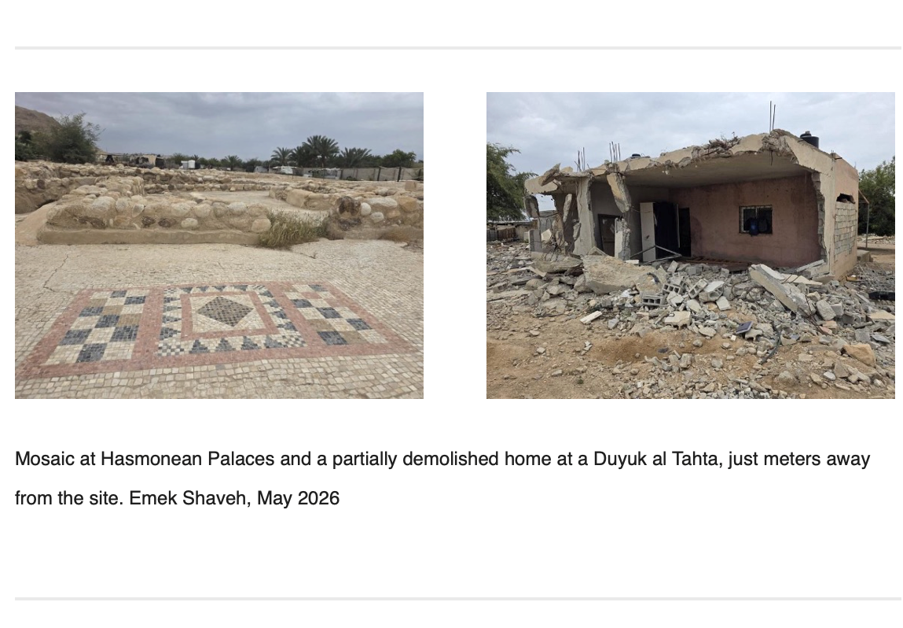
Another ceremony by the minister, held at the Hasmonean Palaces in Jericho in February, was posted a day before settlers destroyed homes in the adjacent community of Duyuk al-Tahta, leaving approximately 100 people homeless. The demolition, carried out with heavy machinery, was allowed to proceed unhindered despite the presence of the army.
In Hebron, a visitors’ center focusing on Chabad’s activities in the city was inaugurated, giving government ministers yet another opportunity to denounce UNESCO. And last week, Orit Strook and Amihai Eliyahu erected a sign on Mount Ebal, in Area B, and delivered speeches to teenage girls brought to the site. Earlier last week, MK Zvi Sukkot of the Religious Zionism party, chair of the Knesset Education, Culture and Sports Committee, swam in Solomon’s Pools/Burak Suleiman in Area A
Solomon’s Pools/Burak Suleiman in Area A.
Emek Shaveh: It appears that with the impending collapse of the government and the dissolution of the Knesset, lawmakers and administration officials are rushing through sectarian processes aimed at creating a messianic “victory image” for their voters, which is currently reflected in unprecedented levels of human rights violations throughout the occupied territories of the West Bank, East Jerusalem and Gaza.
These actions build on a series of earlier decisions concerning antiquities and heritage sites, whose cumulative effect has been to detach the field from its scientific foundations and transform it into a tool for advancing annexation, whether through massive state investment directed exclusively at the West Bank or through legislation transferring responsibility for antiquities there to an Israeli civilian authority.
The pace and scope of the developments on the ground reflect the same logic driving the legislation: a view that the land’s antiquities constitute an exclusive Israeli title deed to the territory and should therefore serve as a vehicle for consolidating Israeli control. Taken together, the changes on the ground and the advancement of the Heritage Authority Bill seek to make formal annexation little more than a bureaucratic formality. That this approach runs contrary to accepted legal, diplomatic, and academic norms appears to be of little concern to a government determined to advance its ultra-nationalist agenda at all costs.